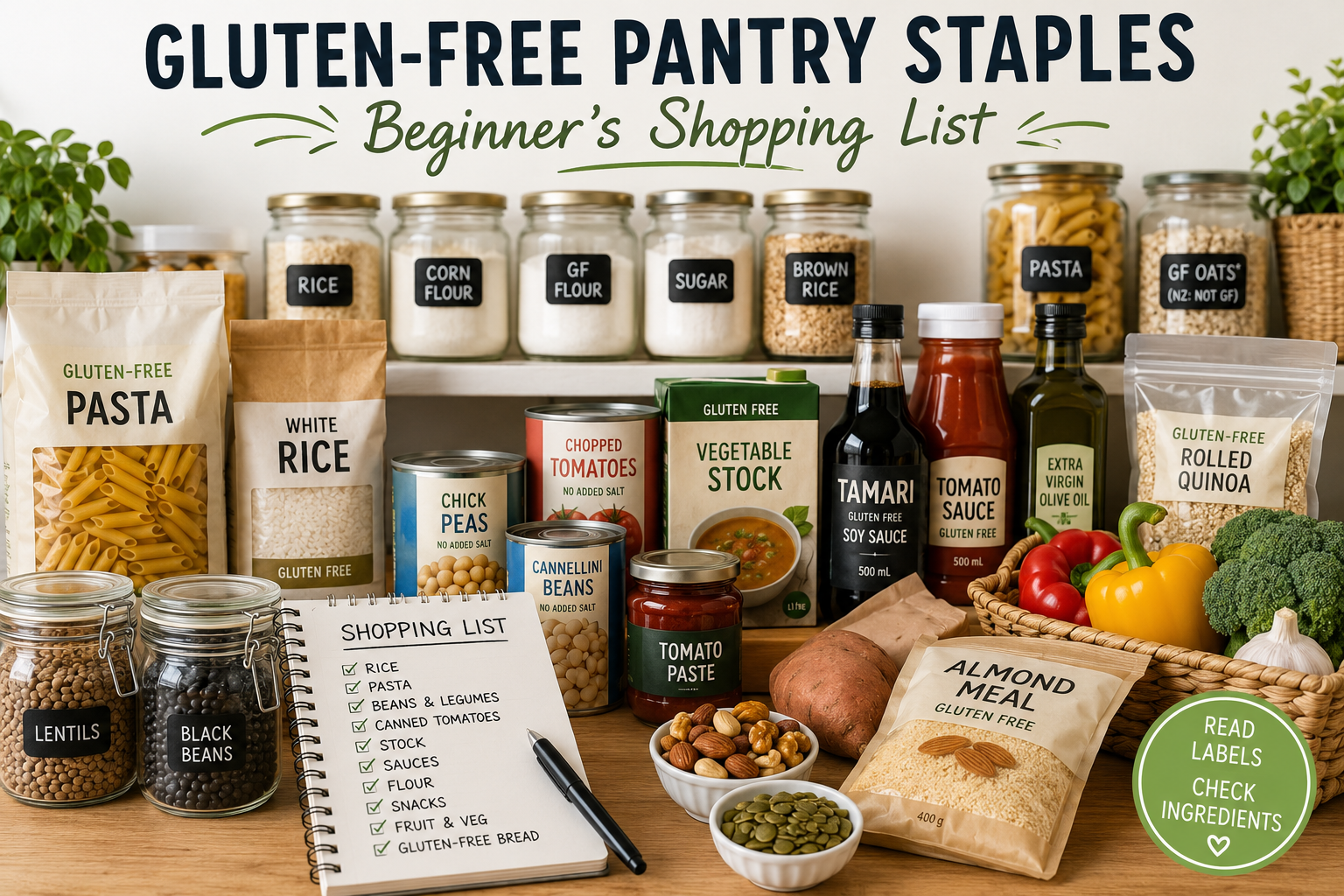
Starting a gluten-free diet can make an ordinary trip to the supermarket suddenly feel complicated.
Before being diagnosed with coeliac disease, you may never have thought twice about buying pasta, stock, sauces, cereal or flour. Now you might find yourself standing in the supermarket reading every ingredient list and wondering:
Is this gluten free?
What should I actually keep in my pantry?
Do I need to buy everything from the gluten-free section?
Why is gluten-free food so expensive?
The good news is that creating a useful gluten-free pantry doesn’t mean filling your cupboards with expensive specialty products.
Many everyday foods are naturally gluten free.
The trick is learning which basic ingredients can form the foundation of your meals, which packaged foods need their labels checked, and which gluten-free replacements are actually worth buying.
This gluten free pantry staples guide will help you build a practical pantry without buying dozens of products you may never use.
Start With Naturally Gluten-Free Foods
When you’re newly diagnosed, it’s easy to focus entirely on replacement products.
Gluten-free bread.
Gluten-free biscuits.
Gluten-free pasta.
Gluten-free cereal.
Gluten-free crackers.
Those products can certainly be useful, but they don’t need to make up your entire diet.
There are plenty of foods that are naturally gluten free.
Building your pantry around these foods can also make gluten-free shopping more affordable.
According to Coeliac New Zealand, naturally gluten-free foods include many fresh fruits and vegetables, plain meat and fish, eggs, dairy foods, rice, corn, potato, pulses, nuts and seeds.
Let’s start building your pantry.
1. Rice
Rice is one of the most useful gluten free pantry staples.
Plain rice is naturally gluten free and can be used for:
- Stir-fries
- Curries
- Rice bowls
- Fried rice
- Salads
- Side dishes
- Stuffed vegetables
- Rice pudding
You might keep several types in your pantry.
For example:
- Long-grain rice
- Basmati rice
- Jasmine rice
- Brown rice
- Arborio rice
Plain rice itself is naturally gluten free, but flavoured rice packets and instant rice mixes can contain additional ingredients.
Always check packaged flavoured products.
2. Corn
Corn is another naturally gluten-free staple.
Depending on what you cook, you might keep:
- Canned corn
- Frozen corn
- Polenta
- Cornmeal
However, don’t assume every corn-based processed product is automatically gluten free.
Corn chips, flavoured popcorn and other packaged corn products can contain additional ingredients or be subject to manufacturing considerations.
Read the label.
3. Potatoes and Kumara
Technically these probably won’t live in your pantry cupboard, but they’re worth including because they’re inexpensive, versatile naturally gluten-free foods.
Potatoes can become:
- Mashed potatoes
- Roast potatoes
- Baked potatoes
- Homemade chips
- Potato salad
- Soup
- Hash browns
Kumara, or sweet potato, is similarly versatile.
This is an important mindset change after a coeliac diagnosis.
You don’t always need a special gluten-free replacement.
Instead of buying an expensive specialty carbohydrate for every meal, sometimes the answer is simply:
potatoes + protein + vegetables.
4. Beans
Canned and dried beans can be excellent pantry foods.
Examples include:
- Kidney beans
- Black beans
- Cannellini beans
- Butter beans
- Pinto beans
Use them in:
- Chilli
- Soups
- Salads
- Nachos
- Tacos
- Stews
- Rice bowls
Plain beans are naturally gluten free, but check the ingredients of canned beans that contain sauces, flavourings or seasonings.
5. Chickpeas
Chickpeas are another useful staple.
They can be used for:
- Curries
- Salads
- Soups
- Homemade hummus
- Roasted snacks
Canned chickpeas also make an easy emergency pantry ingredient when you haven’t planned dinner.
Drain them, rinse them and add them to a suitable curry or salad.
6. Lentils
Lentils are inexpensive, filling and useful for adding protein and fibre to meals.
You can use them in:
- Soup
- Curry
- Dahl
- Stews
- Vegetarian bolognese
- Salads
As with other packaged foods, check the label and follow the gluten-free guidance relevant to where you live.
7. Canned Tomatoes
I would put canned tomatoes near the top of a beginner’s gluten-free shopping list.
They’re cheap and incredibly useful.
Keep:
- Chopped tomatoes
- Crushed tomatoes
- Whole tomatoes
- Tomato puree or passata
depending on what you normally cook.
You can use them to make:
- Pasta sauce
- Curry
- Chilli
- Soup
- Stew
- Pizza sauce
- Mexican-style dishes
Check products containing added herbs, flavourings or other ingredients.
8. Tomato Paste
A small container of tomato paste can add flavour to countless meals.
Use it in:
- Bolognese
- Soup
- Stew
- Pizza sauce
- Chilli
- Casseroles
Again, check the product label rather than assuming every brand or variety is identical.
9. Canned Fish
Suitable canned fish can be another useful cupboard staple.
Depending on what you like, you might keep:
- Tuna
- Salmon
- Sardines
Plain varieties can be useful for quick lunches and dinners.
For example:
Tuna + baked potato + cheese + salad
can make a very simple gluten-free meal.
Check flavoured varieties carefully because sauces and seasonings add extra ingredients.
10. Nuts
Plain nuts can be useful for snacks, baking and meals.
Examples include:
- Almonds
- Walnuts
- Cashews
- Peanuts
- Pecans
However, flavoured, coated and seasoned nuts need checking.
Products with added flavourings can have very different ingredients from plain nuts.
11. Seeds
Seeds can be useful for adding texture and nutrition to meals.
Examples include:
- Pumpkin seeds
- Sunflower seeds
- Chia seeds
- Sesame seeds
- Linseeds/flaxseeds
They can be added to:
- Salads
- Smoothies
- Suitable cereal
- Baking
Check packaged products as appropriate.
12. Gluten-Free Pasta
This is one specialty replacement I think is worth keeping in the pantry.
Pasta makes quick dinners incredibly easy.
Gluten-free pasta can be made from ingredients such as:
- Corn
- Rice
- Legumes
- Blends of gluten-free ingredients
Different brands can have very different textures.
If you dislike the first gluten-free pasta you try, don’t assume you hate gluten-free pasta.
Try another brand.
Cooking Gluten-Free Pasta
Gluten-free pasta can behave differently from regular wheat pasta.
A few tips:
- Follow the packet cooking instructions.
- Don’t overcook it.
- Stir it while cooking.
- Taste it before draining.
- Serve relatively quickly.
And in a shared kitchen, don’t cook gluten-free pasta in water that has been used for wheat pasta.
Use clean water, clean utensils and an appropriately clean or dedicated colander.
13. Gluten-Free Bread
Bread is often one of the first things people replace after a coeliac diagnosis.
Unfortunately, gluten-free bread can also be one of the more expensive items in your shopping trolley.
You don’t necessarily need to eat it every day.
Use alternatives such as:
- Baked potatoes
- Rice
- Leftovers
- Salads
- Suitable corn tortillas
- Other naturally gluten-free meal bases
when appropriate.
This can reduce your grocery costs significantly.
When you do buy gluten-free bread, freezing it can help prevent waste if you don’t use it quickly.
14. Gluten-Free Flour
If you bake, you’ll want at least one gluten-free flour option.
The easiest place to start is often a gluten-free flour blend designed as a replacement for ordinary flour.
Different blends behave differently because gluten normally contributes important structure and elasticity to baked goods.
A recipe specifically developed to be gluten free is often easier for beginners than trying to convert every wheat-based recipe yourself.
Check Gluten-Free Flour Labels
Don’t assume a flour is safe simply because the ingredient it’s made from is naturally gluten free.
Processing and packaging matter too.
Look for products appropriately labelled gluten free according to the rules where you live.
For New Zealand readers, Food Standards Australia New Zealand (FSANZ) is the official source for Australian and New Zealand food standards.
15. Cornflour / Cornstarch
This one requires a little attention because terminology varies between countries.
In New Zealand, products sold as cornflour can have different formulations, so don’t rely on the product name alone.
Read the ingredient list and look for appropriate gluten-free labelling.
Suitable corn starch can be useful for:
- Thickening sauces
- Thickening gravy
- Baking
- Desserts
16. Gluten-Free Breadcrumbs
You don’t necessarily need breadcrumbs every week, but they’re handy to have.
Use suitable gluten-free breadcrumbs for:
- Meatballs
- Burger patties
- Crumbed chicken
- Crumbed fish
- Toppings
You can also make breadcrumbs from leftover gluten-free bread.
Freeze them so they don’t go to waste.
17. Stock
Stock is something many newly diagnosed people don’t think to check.
It’s easy to assume:
“It’s chicken stock. Why would gluten be in that?”
But stock cubes, powders and liquid stocks can contain numerous ingredients.
Check:
- Chicken stock
- Beef stock
- Vegetable stock
- Stock cubes
- Stock powders
Once you find a suitable brand you like, it becomes an easy pantry staple.
Still check labels periodically because product formulations can change.
18. Gravy
Regular gravy products may contain wheat flour or other gluten-containing ingredients.
Fortunately, gluten-free gravy products are available.
You can also make gravy using suitable gluten-free thickening ingredients.
Keep one reliable option in your pantry so you aren’t trying to solve the gravy problem five minutes before serving a roast dinner.
19. Soy Sauce
Soy sauce is one of the classic hidden gluten sources people discover after a coeliac diagnosis.
Many traditional soy sauces contain wheat.
That doesn’t mean you have to give up meals that use soy sauce.
Look for an appropriately labelled gluten-free alternative, such as suitable gluten-free tamari or gluten-free soy sauce.
Then you can continue making:
- Stir-fries
- Fried rice
- Marinades
- Dipping sauces
Always check the actual product label.
20. Herbs and Spices
Plain herbs and spices can transform inexpensive ingredients into much more interesting meals.
Useful basics might include:
- Garlic powder
- Paprika
- Cumin
- Turmeric
- Oregano
- Basil
- Rosemary
- Thyme
- Cinnamon
However, seasoning blends can contain additional ingredients, so check labels.
Examples include:
- Taco seasoning
- Chicken seasoning
- BBQ seasoning
- Curry blends
- Gravy seasonings
Don’t assume that a product is suitable simply because most of it is spice.
21. Cooking Oils
Plain oils are naturally gluten free.
Depending on how you cook, you might keep:
- Olive oil
- Canola oil
- Vegetable oil
The bigger issue is what happens after the oil is used.
Don’t reuse oil that has cooked gluten-containing battered or crumbed food for gluten-free food.
22. Vinegar
Many vinegars can be suitable for a gluten-free diet, but malt vinegar is an important exception to recognise because malt is typically derived from barley.
Check the label and choose an appropriate product.
Useful options can include suitable:
- White vinegar
- Apple cider vinegar
- Wine vinegar
- Balsamic vinegar
depending on the individual product.
23. Sugar
Plain sugar doesn’t contain gluten.
You might keep:
- White sugar
- Brown sugar
- Icing sugar/powdered sugar
However, in a shared baking kitchen, protect your sugar from wheat flour.
If someone dips a flour-covered measuring cup into the sugar container, you’ve introduced cross-contact.
Dedicated gluten-free baking containers can make this much easier.
24. Cocoa
Suitable cocoa powder is useful for gluten-free baking and desserts.
Use it for:
- Cakes
- Brownies
- Biscuits
- Icing
- Hot chocolate recipes
Check the label of the product you’re buying, particularly drinking chocolate and flavoured chocolate powders, which may contain additional ingredients.
25. Baking Powder and Baking Soda
If you bake regularly, keep suitable versions of these in your gluten-free baking supplies.
Protect them from wheat flour in a shared kitchen.
One simple idea is to create a box labelled:
GLUTEN-FREE BAKING
and keep all your baking ingredients together.
Don’t Buy Everything at Once
Your first gluten-free shopping trip doesn’t need to look like this:
“I’ll take one of everything with GLUTEN FREE written on it.”
That can become extremely expensive.
Instead, think about what you actually eat.
If you’ve never baked bread in your life, you probably don’t need five different gluten-free bread flours.
If you don’t eat cereal, don’t buy three boxes just because they’re gluten free.
Build your pantry around your normal meals.
A Simple Starter Pantry
If I were setting up a gluten-free pantry from scratch, I’d begin with something like:
- Rice
- Potatoes
- Canned tomatoes
- Beans
- Chickpeas
- Lentils
- Suitable canned tuna
- Nuts
- Seeds
- Gluten-free pasta
- Gluten-free bread
- Gluten-free flour
- Suitable stock
- Suitable gravy
- Gluten-free soy sauce or tamari
- Cooking oil
- Herbs and spices
Then I’d add specialty products only as I discovered that I actually needed them.
Gluten-Free Doesn’t Have to Mean Expensive
One of the biggest complaints about a gluten-free diet is the cost.
And it’s true that specialty gluten-free products can cost considerably more than conventional versions.
But compare:
Specialty gluten-free snack bar
with
banana
or:
expensive gluten-free ready meal
with
rice + chicken + vegetables
or:
specialty gluten-free lunch product
with
leftover homemade dinner
Naturally gluten-free foods can help keep your grocery budget under control.
You don’t have to buy everything from the supermarket’s gluten-free aisle.
A Good Rule for Beginners
When building your pantry, think:
FIRST: Naturally Gluten Free
Rice, potatoes, vegetables, fruit, plain meat, eggs, legumes, nuts and other suitable basics.
SECOND: Essential Replacements
Bread, pasta, flour and a few sauces you regularly use.
THIRD: Treats and Convenience Foods
Biscuits, cakes, snack bars and other specialty products.
This helps you build a useful pantry rather than an expensive cupboard full of gluten-free snacks.
Keep Checking Labels
Once you’ve bought a product ten times, it’s tempting to stop reading the label.
Try not to get too complacent.
Manufacturers can change ingredients and production processes.
Check packaging, particularly when:
- The packaging changes.
- A product says “new recipe.”
- You haven’t bought it for a while.
- You’re buying a different flavour.
- You’re buying it in another country.
Your safe product list isn’t necessarily permanent.
New Zealand Gluten-Free Labelling
If you live in New Zealand, it’s important to use information relevant to New Zealand and Australia rather than relying entirely on American or European websites.
Australia and New Zealand share food standards administered through FSANZ.
The Australia New Zealand Food Standards Code sets requirements around claims such as gluten free.
For current requirements, see:
Food Standards Australia New Zealand
For practical coeliac-specific information in New Zealand, see:
A Special Note About Oats in New Zealand
This is an area where overseas advice can cause considerable confusion.
You may see American or European recipes using products described as gluten-free oats.
However, Australian and New Zealand gluten-free standards differ from those in some overseas markets.
Under the Australia New Zealand Food Standards Code, a food carrying a gluten-free claim must not contain oats or oat products.
Coeliac New Zealand also advises that oats shouldn’t simply be introduced into a coeliac diet without appropriate medical guidance.
So if you’re in New Zealand, don’t copy an overseas gluten-free pantry list and automatically add oats.
Follow local guidance.
This is a great example of why where you live matters when researching coeliac disease online.
Coming Up in Part 2
In Part 2 of Gluten-Free Pantry Staples: The Ultimate Beginner’s Shopping List, we’ll move beyond the basics and tackle the foods that cause much more confusion.
We’ll cover:
- Breakfast foods
- Cereals
- Snacks
- Crackers
- Chips
- Chocolate
- Lollies/sweets
- Sauces and condiments
- Mayonnaise
- Tomato sauce
- BBQ sauce
- Salad dressing
- Soup
- Processed meats
- Sausages
- Deli meat
- Frozen foods
- Convenience meals
- Dairy products
- Cheese
- Yoghurt
- Drinks
- Tea and coffee
- Alcohol
- What “may contain” means
- Gluten-free certification
- The Crossed Grain Logo
Part 2
In Part 1, we started building a practical collection of gluten free pantry staples, including rice, beans, lentils, canned tomatoes, gluten-free pasta, flour, stock, sauces and baking ingredients.
Now we’re moving into the supermarket foods that can be much more confusing.
Breakfast cereal.
Chips.
Chocolate.
Sauces.
Processed meats.
Frozen foods.
Yoghurt.
Drinks.
These are the products where simply knowing that an ingredient is naturally gluten free isn’t always enough. Packaged foods can contain additional ingredients, flavourings and seasonings, so learning how to check them is an important part of managing coeliac disease.
26. Gluten-Free Breakfast Cereal
Breakfast can be one of the first meals that suddenly becomes difficult after a coeliac diagnosis.
Many common breakfast cereals contain ingredients derived from:
- Wheat
- Barley
- Rye
Some also contain barley malt.
Instead of assuming a cereal is safe because the main ingredient appears gluten free, check the entire product.
Look for products appropriately labelled gluten free according to the rules where you live.
What About Rice and Corn Cereals?
A cereal being made primarily from rice or corn doesn’t automatically mean it’s suitable for someone with coeliac disease.
Other ingredients may be added.
For example, a cereal may contain:
- Malt
- Flavourings
- Additional grains
- Coatings
This is why reading the actual label matters more than looking at the picture on the front of the box.
Remember the Rules Around Oats in New Zealand
This is worth repeating because it can be extremely confusing for newly diagnosed New Zealanders.
You may find overseas websites recommending products containing “gluten-free oats.”
However, food labelled gluten free under Australian and New Zealand standards must not contain oats or oat products.
Coeliac New Zealand also recommends that people with coeliac disease seek appropriate medical guidance before considering oats.
For New Zealand-specific information, use:
For current food standards:
Food Standards Australia New Zealand (FSANZ)
27. Gluten-Free Crackers
Crackers are useful for:
- Lunches
- Cheese boards
- Snacks
- Dips
Keeping one packet of gluten-free crackers in the pantry can be handy.
But you don’t need six different varieties.
Try one or two until you find something you genuinely enjoy.
Once opened, store them properly because some gluten-free crackers can go stale quickly.
28. Corn Chips and Tortilla Chips
Plain corn is naturally gluten free.
That doesn’t mean every bag of corn chips is suitable.
Check for:
- Seasonings
- Flavourings
- Added ingredients
- Allergen information
- Gluten-free claims where applicable
Flavoured varieties can have completely different ingredients from plain versions.
Don’t assume that because one flavour from a brand is suitable, all of them are.
29. Potato Chips
Potatoes are naturally gluten free.
Packaged potato chips are more complicated.
Flavours such as:
- Chicken
- BBQ
- Cheese
- Sour cream
- Salt and vinegar
can contain numerous ingredients.
Even plain varieties should be checked according to the product labelling and guidance relevant to your country.
30. Popcorn
Plain corn is naturally gluten free, so homemade popcorn can be a simple snack.
Packaged flavoured popcorn may contain additional ingredients.
Check products containing:
- Cheese flavouring
- Caramel coatings
- Seasoning mixes
- Chocolate
- Other coatings
Again, plain ingredient = simple.
Processed product = check the label.
31. Chocolate
Chocolate is one of those foods people immediately worry they’ll have to give up.
Thankfully, having coeliac disease doesn’t automatically mean no more chocolate.
But you need to check the individual product.
Chocolate can contain additions such as:
- Biscuit pieces
- Wafer
- Malt
- Cookie pieces
- Pretzels
- Cereals
Even products from the same manufacturer can differ significantly.
A plain chocolate bar and a biscuit-filled version aren’t the same product.
Check each one.
32. Lollies and Sweets
The same principle applies to lollies, sweets and confectionery.
Some products may be suitable while others contain gluten-containing ingredients.
Check things such as:
- Liquorice
- Wafer-filled sweets
- Malt-containing products
- Biscuit-containing confectionery
Don’t rely on what someone told you five years ago.
Check the current packaging.
33. Snack Bars
Snack bars are particularly important for New Zealand readers because many overseas gluten-free snack recommendations contain oats.
Check every bar individually.
Ingredients may include:
- Oats
- Cereals
- Malt
- Biscuit pieces
- Flavourings
If you’re looking for an emergency snack to keep in your handbag, choose something clearly suitable for your diet.
34. Tomato Sauce
Tomatoes themselves are gluten free.
A bottle of tomato sauce contains more than tomatoes.
Different products have different recipes.
Check the ingredients and allergen information of the particular product you’re buying.
Once you find a suitable everyday tomato sauce, it becomes a useful fridge staple.
35. BBQ Sauce
BBQ sauce can contain a long list of ingredients.
Check the individual product rather than assuming it’s suitable.
This is particularly important when eating at someone else’s house.
You might carefully bring gluten-free sausages and then cover them with a sauce you haven’t checked.
36. Mayonnaise
Mayonnaise is another product that needs checking individually.
Even when the ingredients appear straightforward, use the product label to determine whether it fits your gluten-free diet.
There’s also a second problem:
crumbs.
A suitable mayonnaise can become contaminated when someone uses a knife on regular bread and then puts it back into the jar.
In a shared kitchen, consider:
- Separate mayonnaise
- Squeeze bottles
- A strict clean-utensil rule
37. Mustard
Mustard products vary.
Some contain only a few ingredients, while flavoured mustards can contain much more.
Check:
- Dijon mustard
- Wholegrain mustard
- American-style mustard
- Honey mustard
individually.
38. Salad Dressing
Salad itself may be naturally gluten free.
The dressing might not be.
Check bottled:
- Caesar dressing
- Ranch-style dressing
- Balsamic dressings
- Vinaigrettes
- Creamy dressings
This is also something to remember when eating at restaurants.
Don’t assume:
“I’ll just order a salad.”
automatically means the meal will be suitable.
39. Soy Sauce
This deserves another mention because it’s such a common surprise.
Traditional soy sauce commonly contains wheat.
Keep an appropriately labelled gluten-free soy sauce or suitable tamari in your kitchen if you regularly cook Asian-inspired meals.
Then you can make:
- Stir-fries
- Fried rice
- Marinades
- Dipping sauces
without having to reinvent every recipe.
40. Worcestershire Sauce
Worcestershire sauce recipes vary by manufacturer and country.
Check the individual bottle.
This is another example of why lists online saying:
“Brand X is gluten free”
can become outdated or may not apply to the product sold in your country.
The package in your hand is more useful than an old social-media comment.
41. Soup
Soup can be surprisingly tricky.
Homemade soup is relatively easy to control because you choose the ingredients.
Packaged and canned soups can contain:
- Wheat flour
- Pasta
- Noodles
- Barley
- Thickeners
- Stock
- Seasonings
Check every product.
Even something that sounds simple, such as tomato or vegetable soup, can contain ingredients you weren’t expecting.
42. Stock
Stock deserves a permanent place on your label-checking list.
Don’t assume:
chicken stock = chicken + water.
Commercial products can contain many ingredients.
Check:
- Cubes
- Powders
- Liquid stock
- Concentrated stock
Once you find a suitable product, keep it stocked because it’s used in so many recipes.
43. Gravy
Traditional gravy can be thickened with wheat flour.
Packaged gravy mixes may also contain gluten-containing ingredients.
Look for a suitable gluten-free option or make your own using appropriate ingredients.
This is one product worth sorting out before Christmas dinner rather than discovering the problem when everything else is already on the table.
44. Sausages
Plain fresh meat is naturally gluten free.
Sausages are processed food.
They can contain:
- Fillers
- Breadcrumbs
- Seasonings
- Flavourings
- Sauces
Check the package or ask the butcher for ingredient and allergen information.
Don’t assume all sausages are gluten free.
45. Burger Patties
The same applies to burger patties.
A patty made from nothing but plain minced beef is different from a commercial burger containing:
- Breadcrumbs
- Seasonings
- Sauces
- Fillers
Check first.
46. Meatballs
Traditional meatball recipes frequently contain breadcrumbs.
If you’re buying premade meatballs, read the label.
At home, you can make your own using suitable gluten-free breadcrumbs or another appropriate gluten-free recipe.
47. Deli Meat
Processed and flavoured deli meats need checking.
This might include:
- Ham
- Chicken
- Salami
- Luncheon meats
- Flavoured sliced meats
There can also be practical cross-contact concerns at deli counters where equipment and preparation surfaces are shared.
If you’re uncertain, packaged products with clear ingredient and allergen information may be easier to assess.
48. Marinated Meat
Here’s another easy trap.
You look at a packet and think:
“It’s chicken. Chicken is gluten free.”
The chicken may be.
The marinade might not be.
Check marinated:
- Chicken
- Beef
- Pork
- Lamb
- Kebabs
for sauces, soy sauce and seasonings.
49. Frozen Chips
Potatoes are naturally gluten free.
Frozen chips are manufactured products.
Some may contain additional coatings, seasonings or ingredients.
Read the packaging.
And remember that preparation matters too.
A suitable frozen chip cooked at home in appropriately managed equipment is different from a chip cooked in restaurant oil shared with battered gluten-containing foods.
50. Frozen Vegetables
Plain frozen vegetables are often a useful, affordable staple.
They can also reduce food waste because you use only what you need.
Keep things such as:
- Peas
- Corn
- Mixed vegetables
- Spinach
- Broccoli
depending on what you eat.
Products containing sauces or seasonings need additional checking.
51. Frozen Fruit
Frozen fruit is useful for:
- Smoothies
- Desserts
- Baking
Plain frozen fruit can be a convenient way to keep berries and other fruits available year-round.
Again, check packaged products where appropriate.
52. Frozen Ready Meals
Ready meals can be convenient, but don’t judge them by the meal name.
A product called:
Beef and Vegetables
might still contain gluten-containing:
- Gravy
- Sauce
- Stock
- Seasoning
Look for suitable gluten-free products and read the ingredients.
53. Cheese
Plain cheese is generally naturally gluten free.
Processed and flavoured cheese products can contain additional ingredients, so check where appropriate.
This includes products such as:
- Cheese spreads
- Cheese sauces
- Flavoured cheese
- Processed cheese snacks
54. Yoghurt
Plain yoghurt can be straightforward.
Flavoured yoghurts and products containing toppings may have additional ingredients.
Pay particular attention to yoghurt products containing:
- Granola
- Cereal
- Biscuit pieces
- Crumb toppings
Check the full product rather than just the yoghurt portion.
55. Ice Cream
Ice cream can contain obvious gluten ingredients such as:
- Cookies
- Biscuit pieces
- Brownie pieces
- Wafers
- Cake
- Malt
Other flavours require checking individually.
If you’re eating ice cream from a scoop shop, there’s also potential for cross-contact through shared scoops and crumbs from cones or toppings.
56. Milk
Plain milk is naturally gluten free.
Flavoured milk products contain additional ingredients and should be checked individually.
The same principle applies to many milk alternatives.
Check the actual product you’re purchasing.
57. Tea
Plain tea is generally straightforward.
However, flavoured and specialty tea blends can contain many additional ingredients.
If you’re buying a complex blend, check the packaging.
58. Coffee
Plain coffee is naturally gluten free.
More complicated café drinks may contain:
- Flavoured syrups
- Powders
- Toppings
- Sauces
If you’re unsure, ask about the additional ingredients.
59. Hot Chocolate
Don’t assume drinking chocolate or hot chocolate powder is the same as plain cocoa.
Commercial drinking chocolate can contain numerous ingredients.
Check the product.
60. Soft Drinks and Juice
Many ordinary soft drinks and juices may be suitable, but always assess the actual product rather than relying on a general list.
This becomes particularly important with unusual, flavoured or specialty drinks.
61. What About Alcohol?
Alcohol can be confusing after a coeliac diagnosis.
Some alcoholic drinks are made from gluten-containing grains, while production methods and gluten-free suitability differ between beverage types.
Beer is an obvious area requiring attention because conventional beer is commonly made using barley or other gluten-containing grains.
Gluten-free beers are available in some markets.
Wine and plain spirits involve different considerations, but mixed drinks, premixes, flavourings and other additions may introduce additional ingredients.
For personalised advice and current local guidance, check with your national coeliac organisation and the individual manufacturer.
For New Zealand readers:
What Does “Gluten Free” on a Label Mean in New Zealand?
For New Zealand and Australian shoppers, gluten-free claims are regulated under the Australia New Zealand Food Standards Code.
Under the Code, food carrying a gluten free claim must not contain detectable gluten and must not contain oats or oat products, or cereals containing gluten that have been malted or their products.
For the current legal requirements, check:
Food Standards Australia New Zealand
This is one reason an appropriately labelled gluten-free product can make shopping much easier for someone newly diagnosed.
What Is the Crossed Grain Logo?
You may notice a crossed-grain symbol on some gluten-free foods.
Coeliac New Zealand operates the Crossed Grain Logo certification programme in New Zealand.
Certified products have undergone the programme’s certification process and provide another useful way for shoppers with coeliac disease to identify suitable products.
You can learn more from:
What Does “May Contain” Mean?
Precautionary allergen statements such as:
“May contain…”
can be one of the most confusing parts of label reading.
These statements can relate to possible unintended presence resulting from manufacturing or handling.
Don’t create your own universal rule based on advice from Facebook groups or overseas websites.
Labelling rules and recommendations can differ between countries.
If you’re in New Zealand and aren’t sure how to interpret a particular label, use current guidance from Coeliac New Zealand and FSANZ or speak with an appropriately qualified dietitian.
This is also an excellent place in your finished article to internally link to your:
How to Read Gluten-Free Food Labels: A Beginner’s Guide
because that article explains label reading in much greater detail.
Don’t Rely on the “Free From” Aisle
The gluten-free aisle can be helpful.
But don’t make the mistake of thinking it’s the only part of the supermarket where you can shop.
Your trolley can still contain plenty of everyday foods from:
- Produce
- Meat
- Dairy
- Canned goods
- Frozen vegetables
- Rice
- Legumes
Specialty gluten-free foods are useful replacements.
They don’t need to become your entire diet.
Be Careful With Imported Products
Imported products can be particularly confusing because gluten-free labelling requirements vary around the world.
Something purchased online or imported from another country may have been labelled under different regulations.
For New Zealand readers, don’t automatically assume that an overseas product follows the same rules as a product making a gluten-free claim under Australian/New Zealand standards.
When you’re uncertain, investigate before eating it.
Don’t Assume Different Flavours Are the Same
This is such an easy mistake.
Imagine you regularly buy:
Original flavour chips
and know they’re suitable.
You see:
BBQ flavour
from the same company.
That doesn’t automatically mean they’re identical from a gluten perspective.
The flavouring ingredients can be completely different.
Treat each flavour as its own product.
Don’t Assume Different Sizes Are Always Identical Either
Manufacturing arrangements and packaging can sometimes differ between products and markets.
The safest habit is simple:
Read the package you’re actually buying.
It takes seconds once you become familiar with label reading.
A Useful Supermarket Routine
When you’re newly diagnosed, shopping can take forever.
Try this routine.
Step 1: Buy Naturally Gluten-Free Foods First
Fruit.
Vegetables.
Plain meat.
Rice.
Potatoes.
Legumes.
Step 2: Buy Your Known Staples
Products you’ve previously checked and regularly use.
Step 3: Check New Products
Take your time reading unfamiliar labels.
Step 4: Buy Specialty Replacements Last
Bread.
Pasta.
Crackers.
Flour.
Treats.
This prevents the gluten-free specialty aisle from swallowing half your grocery budget.
Build a List of Your Safe Favourites
Your first few shopping trips may be slow.
Eventually you’ll have your own list:
My bread
My pasta
My stock
My soy sauce
My crackers
My cereal
My gravy
My snacks
Shopping becomes much easier because you aren’t researching every single item every week.
Still check labels periodically, especially if packaging or recipes change.
Coming Up in Part 3
We’ll include:
✓ Complete gluten-free pantry checklist
✓ Fridge checklist
✓ Freezer checklist
✓ Baking cupboard checklist
✓ First supermarket shopping list
✓ Budget gluten-free shopping list
✓ 7 cheap meal combinations using pantry staples
✓ Foods you don’t need to buy gluten-free versions of
✓ Products that always deserve a label check
✓ Common shopping mistakes
✓ Frequently asked questions
✓ Trusted New Zealand resources
Part 3
Now that we’ve covered the main gluten free pantry staples, packaged foods, sauces, snacks, frozen foods and drinks, it’s time to put everything together into a shopping system you can actually use.
When you’re newly diagnosed with coeliac disease, supermarket shopping can feel incredibly slow.
You pick up a product.
Read the ingredients.
Put it back.
Pick up another one.
Google something.
Read another label.
Then somehow you’ve spent an hour in the supermarket and only bought twelve things.
It does get easier.
Once you’ve built a basic pantry and found products you regularly use, shopping becomes much more routine.
This final section gives you practical checklists you can save and use while building your gluten-free kitchen.
Complete Gluten-Free Pantry Checklist
You don’t need every item on this list.
Choose the foods you and your family actually eat.
Grains, Starches and Meal Bases
Consider keeping suitable:
☐ Rice
☐ Gluten-free pasta
☐ Polenta
☐ Cornmeal
☐ Potatoes
☐ Kumara/sweet potato
☐ Suitable corn tortillas
☐ Other gluten-free grains you regularly use
These ingredients can form the base of inexpensive meals without relying heavily on specialty gluten-free products.
Canned Food Checklist
Useful pantry options include:
☐ Canned tomatoes
☐ Tomato paste
☐ Passata
☐ Chickpeas
☐ Kidney beans
☐ Black beans
☐ Cannellini beans
☐ Lentils
☐ Suitable canned tuna
☐ Suitable canned salmon
☐ Corn
☐ Other plain canned vegetables
Check products containing sauces, flavourings or seasonings.
Sauces and Condiments Checklist
Check every individual product.
You might want suitable versions of:
☐ Tomato sauce/ketchup
☐ BBQ sauce
☐ Mayonnaise
☐ Mustard
☐ Salad dressing
☐ Gluten-free soy sauce or suitable tamari
☐ Worcestershire sauce
☐ Hot sauce
☐ Pasta sauce
☐ Curry sauces or pastes
☐ Marinades
☐ Gravy
☐ Stock
Once you’ve found suitable everyday products, these make quick meals much easier.
Herbs, Spices and Seasonings
Keep whatever you actually cook with.
For example:
☐ Salt
☐ Pepper
☐ Paprika
☐ Cumin
☐ Turmeric
☐ Garlic powder
☐ Onion powder
☐ Oregano
☐ Basil
☐ Rosemary
☐ Thyme
☐ Cinnamon
☐ Suitable curry powder
☐ Suitable seasoning blends
Remember that a plain herb or spice and a commercial seasoning mix aren’t necessarily the same thing.
Seasoning blends can contain additional ingredients, so check them individually.
Gluten-Free Baking Cupboard Checklist
If you enjoy baking, you might keep:
☐ Gluten-free flour blend
☐ Suitable cornflour/cornstarch
☐ Baking powder
☐ Baking soda
☐ Cocoa
☐ White sugar
☐ Brown sugar
☐ Icing sugar
☐ Suitable chocolate chips
☐ Suitable vanilla/flavourings
☐ Gluten-free breadcrumbs
☐ Suitable cake decorations
☐ Suitable sprinkles
☐ Baking paper
In a shared kitchen, protect these ingredients from regular wheat flour.
A large container labelled GLUTEN-FREE BAKING can make this much easier.
Snack Cupboard Checklist
You don’t need a cupboard filled with expensive gluten-free snacks.
Choose a few favourites.
Depending on the individual product, you might keep:
☐ Gluten-free crackers
☐ Suitable corn chips
☐ Suitable potato chips
☐ Popcorn
☐ Nuts
☐ Seeds
☐ Dried fruit
☐ Suitable chocolate
☐ Suitable lollies/sweets
☐ Gluten-free snack bars
☐ Gluten-free biscuits
Always check packaged products.
Fridge Checklist
Your gluten-free diet isn’t just about the pantry.
Useful fridge foods can include:
☐ Milk
☐ Cheese
☐ Suitable yoghurt
☐ Butter
☐ Eggs
☐ Fresh meat
☐ Fresh fish
☐ Fruit
☐ Vegetables
☐ Suitable sauces
☐ Suitable dips
☐ Gluten-free bread if refrigerated
☐ Leftovers
In a shared household, consider separate butter and other spreads that regularly come into contact with knives used on bread.
Freezer Checklist
Your freezer can save both time and money.
Consider keeping:
☐ Frozen vegetables
☐ Frozen fruit
☐ Gluten-free bread
☐ Suitable frozen chips
☐ Plain meat
☐ Homemade gluten-free meals
☐ Leftover portions
☐ Gluten-free baking
☐ Suitable convenience foods
Label homemade food clearly.
For example:
GF CHICKEN CURRY – 20 AUG
instead of relying on your memory three months later.
Your First Gluten-Free Supermarket Shopping List
If you’ve just been diagnosed and have no idea where to begin, don’t buy everything in this article.
Start here.
Produce
☐ Potatoes
☐ Kumara
☐ Carrots
☐ Broccoli
☐ Lettuce
☐ Tomatoes
☐ Onions
☐ Bananas
☐ Apples
☐ Seasonal fruit
Protein
☐ Plain chicken
☐ Plain beef/mince
☐ Plain fish
☐ Eggs
☐ Beans
☐ Chickpeas
☐ Lentils
Carbohydrates
☐ Rice
☐ Gluten-free pasta
☐ Gluten-free bread
Dairy
☐ Milk
☐ Cheese
☐ Butter
☐ Suitable yoghurt
Pantry
☐ Canned tomatoes
☐ Tomato paste
☐ Suitable stock
☐ Suitable gravy
☐ Gluten-free soy sauce/tamari
☐ Cooking oil
☐ Herbs and spices
Snacks
☐ Fruit
☐ Nuts
☐ Gluten-free crackers
☐ One or two suitable treats
That’s enough to create plenty of meals.
You don’t need a $400 trolley full of specialty gluten-free products on your first shopping trip.
How to Build a Gluten-Free Pantry on a Budget
Gluten-free food can be expensive.
Specialty products in particular can cost significantly more than conventional equivalents.
One of the best ways to control the cost is to stop thinking:
“What gluten-free version can I buy?”
and start asking:
“Is there a naturally gluten-free food I could use instead?”
For example:
Instead of an expensive gluten-free ready meal:
Rice + chicken + frozen vegetables
Instead of specialty lunch products:
Leftovers from dinner
Instead of expensive snack bars:
Banana + handful of suitable nuts
Instead of buying gluten-free bread for every lunch:
Baked potato + suitable toppings
Naturally gluten-free doesn’t automatically mean cheap, but it gives you many more options.
Budget Gluten-Free Shopping List
If money is tight, build meals around inexpensive basics.
Prices vary enormously between countries and supermarkets, but useful foods can include:
☐ Rice
☐ Potatoes
☐ Seasonal vegetables
☐ Frozen vegetables
☐ Canned tomatoes
☐ Beans
☐ Chickpeas
☐ Lentils
☐ Eggs
☐ Seasonal fruit
☐ Suitable canned tuna
☐ Plain meat when on special
☐ Cheese where affordable
☐ Basic herbs and spices
Then buy only the gluten-free specialty replacements you genuinely use.
Don’t Waste Gluten-Free Bread
Gluten-free bread can be expensive, so throwing half a loaf away because it went stale is frustrating.
If you don’t use bread quickly, consider freezing it in a way that lets you remove only what you need.
Keep it protected from regular bread and crumbs.
A dedicated gluten-free toaster or another appropriately managed cooking method can then be used when you need a slice.
Use Your Freezer to Reduce Costs
If suitable meat is discounted, you might freeze portions.
If you make a large gluten-free:
- Curry
- Chilli
- Soup
- Stew
- Pasta sauce
freeze extra servings.
This creates your own convenience food.
On a busy night, instead of buying an expensive gluten-free takeaway, you can pull a meal from the freezer.
Seven Easy Gluten-Free Meals Using Basic Staples
A useful pantry should help you make meals—not simply look organised.
Here are seven simple ideas.
1. Chicken and Rice Bowl
Use:
- Rice
- Plain chicken
- Frozen vegetables
- Suitable gluten-free soy sauce/tamari
2. Baked Potato
Use:
- Potato
- Cheese
- Suitable tuna or beans
- Salad
3. Simple Bolognese
Use:
- Plain mince
- Canned tomatoes
- Tomato paste
- Herbs
- Gluten-free pasta
Make extra sauce and freeze it.
4. Bean Chilli
Use:
- Beans
- Canned tomatoes
- Corn
- Suitable spices
- Rice
This can also be an inexpensive meat-free meal.
5. Easy Curry
Use:
- Chicken or chickpeas
- Vegetables
- Suitable curry paste/powder or sauce
- Rice
Check every packaged ingredient.
6. Roast Dinner
Use:
- Plain meat
- Potatoes
- Kumara
- Vegetables
- Suitable gravy
A roast dinner can be naturally close to gluten free without requiring many specialty products.
7. Gluten-Free Pasta Night
Use:
- Gluten-free pasta
- Canned tomatoes
- Garlic
- Herbs
- Cheese
Simple doesn’t have to mean boring.
Foods You Don’t Necessarily Need Special Gluten-Free Versions Of
This is where you can save money.
You don’t need a special “gluten-free version” of naturally gluten-free foods such as plain:
- Fruit
- Vegetables
- Potatoes
- Rice
- Eggs
- Fresh unprocessed meat
- Fresh fish
- Beans
- Chickpeas
- Lentils
Of course, once these foods are processed, seasoned, coated or combined with other ingredients, you need to check the resulting product.
For example:
Plain chicken: naturally gluten free.
Crumbed chicken: needs checking.
Plain potato: naturally gluten free.
Flavoured frozen potato product: check it.
Products That Deserve a Label Check
Keep this list handy when shopping.
Check:
☐ Sauces
☐ Stock
☐ Gravy
☐ Soup
☐ Seasonings
☐ Breakfast cereal
☐ Snack bars
☐ Chips
☐ Chocolate
☐ Lollies/sweets
☐ Processed meat
☐ Sausages
☐ Burger patties
☐ Meatballs
☐ Marinades
☐ Frozen meals
☐ Flavoured dairy products
☐ Baking ingredients
☐ Flavoured drinks
☐ Imported foods
If you’re uncertain, don’t guess.
Common Gluten-Free Shopping Mistakes
Mistake 1: Assuming Wheat-Free Means Gluten Free
Wheat isn’t the only gluten-containing grain.
Barley and rye also matter.
Mistake 2: Assuming “Natural” Means Gluten Free
The word natural isn’t a substitute for gluten-free information.
Read the label.
Mistake 3: Assuming Organic Means Gluten Free
Organic wheat is still wheat.
A product being organic tells you nothing about whether it’s suitable for coeliac disease.
Mistake 4: Assuming Vegan Means Gluten Free
Vegan and gluten free are completely different dietary descriptions.
A vegan product can contain wheat, barley or rye.
Mistake 5: Assuming Dairy-Free Means Gluten Free
Again, these are unrelated claims.
Mistake 6: Buying Everything From the Gluten-Free Aisle
This can make your grocery bill much higher than necessary.
Shop throughout the supermarket.
Mistake 7: Following American Lists Without Checking NZ Rules
This is particularly important when it comes to oats and gluten-free labelling.
If you’re in New Zealand, use New Zealand/Australian guidance.
Mistake 8: Never Rechecking Favourite Products
Manufacturers can change recipes.
Check packaging regularly, especially when something looks different.
Mistake 9: Assuming Every Flavour Is the Same
One flavour may be suitable while another isn’t.
Check them separately.
Mistake 10: Buying Too Much Specialty Food
When you’re newly diagnosed, it’s tempting to buy every gluten-free product you see.
Start small.
Find out what you actually like.
Then gradually build your pantry.
Your 5-Minute Supermarket Check
When you pick up an unfamiliar packaged product, ask:
1. Does it have an appropriate gluten-free claim?
Check the packaging.
2. What are the ingredients?
Read them.
3. What allergen information is provided?
Check it.
4. Is it imported?
Consider whether you’re looking at labelling from another country.
5. Am I actually unsure?
If so, don’t guess.
Check reliable guidance or contact the manufacturer when appropriate.
For a much more detailed explanation, read our:
How to Read Gluten-Free Food Labels: A Beginner’s Guide
Add an internal link to that article here.
Frequently Asked Questions About Gluten-Free Pantry Staples
What Should I Buy First After Being Diagnosed With Coeliac Disease?
Start with foods you already eat that are naturally gluten free.
Build meals around things such as rice, potatoes, vegetables, fruit, plain meat, eggs and legumes.
Then replace the gluten-containing staples you regularly use, such as bread, pasta, flour, stock and sauces.
Do I Need to Throw Away Everything in My Pantry?
No.
Check products individually.
Some things will clearly contain gluten, while many others may already be suitable.
If you share your home with people who eat gluten, you may choose to keep their food in a separate area.
Is All Rice Gluten Free?
Plain rice is naturally gluten free.
However, flavoured rice products and meal packets contain additional ingredients and need checking.
Are Potatoes Gluten Free?
Plain potatoes are naturally gluten free.
Processed potato products may contain coatings, seasonings or other ingredients, so check those individually.
Are Beans Gluten Free?
Plain beans are naturally gluten free.
Products containing sauces or seasonings require additional checking.
Is Corn Gluten Free?
Plain corn is naturally gluten free.
Processed corn-based foods can contain additional ingredients and should be checked.
Can People With Coeliac Disease Eat Oats?
This requires particular care.
Recommendations and labelling rules vary internationally.
In Australia and New Zealand, foods carrying a gluten-free claim must not contain oats or oat products.
New Zealand readers should follow current local guidance rather than assuming overseas “gluten-free oats” recommendations apply here.
See:
Build Your Own Master Shopping List
After you’ve been gluten free for a while, create a list on your phone.
You might have sections such as:
BREAD
Your preferred product.
PASTA
Your favourite brand/type.
STOCK
The product you normally buy.
SOY SAUCE
Your usual gluten-free option.
CRACKERS
Your favourite.
CEREAL
Your preferred option.
SNACKS
Several reliable choices.
This saves an enormous amount of time.
Instead of starting from scratch every supermarket trip, you have a basic shopping system.
Remember to keep checking packaging periodically because formulations can change.
Final Gluten-Free Pantry Checklist
Before you consider your pantry organised, check:
☐ Rice and meal bases
☐ Gluten-free pasta
☐ Canned tomatoes
☐ Beans and legumes
☐ Suitable stock
☐ Suitable gravy
☐ Gluten-free soy sauce/tamari if used
☐ Suitable sauces
☐ Herbs and spices
☐ Gluten-free flour if you bake
☐ Suitable baking ingredients
☐ Several easy snacks
☐ Emergency meal ingredients
☐ Gluten-free bread if you use it
☐ Freezer backup meals
☐ Pantry foods are protected from wheat flour and crumbs
☐ Everyone in a shared household understands which food is gluten free
That’s enough.
Your pantry doesn’t need to resemble a gluten-free supermarket.
It needs to contain food that allows you to make meals you actually enjoy.
Final Thoughts
Creating a collection of gluten free pantry staples is one of the things that can make life considerably easier after a coeliac disease diagnosis.
At first, every supermarket trip can feel like research.
You read everything.
You question everything.
You discover ingredients you’ve never heard of.
And you may spend far too much money experimenting with gluten-free products you end up not liking.
Over time, that changes.
You’ll find your favourite bread.
You’ll know which pasta you prefer.
You’ll have reliable sauces.
You’ll know which stock you buy.
You’ll have a few emergency meals in the freezer.
And supermarket shopping starts feeling normal again.
The most important lesson is that a gluten-free pantry doesn’t need to consist entirely of products with GLUTEN FREE written across the front.
Build your meals around naturally gluten-free foods.
Buy specialty replacements where they’re useful.
Read packaged-food labels carefully.
Follow the food standards and coeliac guidance relevant to your country.
And build your pantry gradually.
Related Gluten-Free & Coeliac Guides
Coeliac Disease Newly Diagnosed Checklist: What to Do First
Foods You Can Eat With Coeliac Disease: Complete Gluten-Free Food List
Foods to Avoid With Coeliac Disease: Complete Gluten-Free Guide
Common Hidden Sources of Gluten: Foods, Drinks & Everyday Products to Watch Out For
How to Read Gluten-Free Food Labels: A Beginner’s Guide
How to Avoid Gluten Cross-Contamination With Coeliac Disease
The Ultimate Gluten-Free Shopping Guide
Eating Out With Coeliac Disease: How to Stay Gluten Free at Restaurants
How to Get Diagnosed With Coeliac Disease: Symptoms, Testing & Where to Get Help Worldwide
Gluten-Free Kitchen Setup for Coeliac Disease: What to Replace, Clean & Keep
Trusted Resources
Health New Zealand | Te Whatu Ora – https://www.tewhatuora.govt.nz
Coeliac New Zealand – https://coeliac.org.nz
Coeliac Australia – https://www.coeliac.org.au
Coeliac UK – https://www.coeliac.org.uk
Celiac Disease Foundation – https://celiac.org
Beyond Celiac – https://www.beyondceliac.org
Canadian Celiac Association – https://www.celiac.ca
Medical Disclaimer
This article is for general educational purposes and isn’t a substitute for individual medical or dietary advice.
If you have coeliac disease and need help establishing a nutritionally balanced gluten-free diet, speak with your doctor or an appropriately qualified dietitian.
Always check current food labels because ingredients, formulations and manufacturing processes can change.
Leave a Reply
You must be logged in to post a comment.