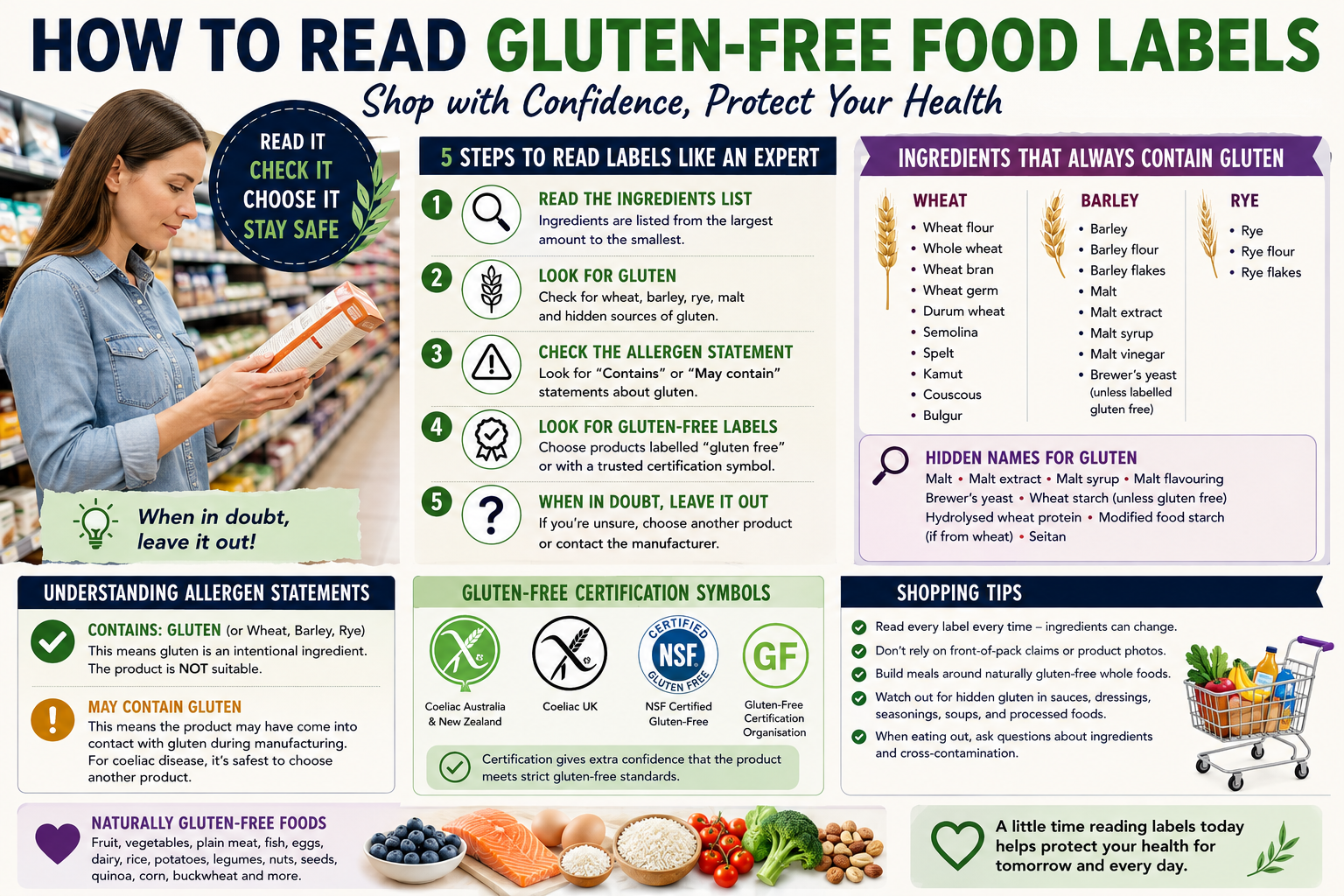
How to Read Gluten-Free Food Labels Like an Expert
Walking into a supermarket after being diagnosed with coeliac disease can feel overwhelming. Foods you’ve bought for years suddenly seem off-limits, ingredient lists look confusing, and you may find yourself spending much longer in the supermarket than you ever did before.
If this sounds familiar, you’re not alone.
One of the biggest challenges people face after a coeliac disease diagnosis isn’t giving up bread or pasta—it’s learning how to identify the hidden sources of gluten found in everyday packaged foods.
The good news is that reading food labels is a skill, and like any skill, it becomes easier with practice.
Once you understand what to look for, you’ll be able to shop more confidently, avoid accidental gluten exposure, and spend less time standing in supermarket aisles reading tiny ingredient lists.
This guide explains everything you need to know about reading gluten-free food labels, from understanding ingredient lists and allergen statements to recognising certification symbols and avoiding common shopping mistakes.
Whether you’ve just been diagnosed or you’re supporting a family member with coeliac disease, this guide will help you make safer food choices with confidence.
Table of Contents
- Why Food Labels Matter
- Understanding Gluten
- Where to Find Ingredients Lists
- Ingredients That Always Contain Gluten
- Hidden Names for Gluten
- Understanding Allergen Statements
- What “Gluten Free” Really Means
- Certification Symbols
- Shopping Tips
- FAQs
Why Reading Food Labels Is So Important
For someone with coeliac disease, reading food labels isn’t just about avoiding stomach discomfort—it’s about protecting your long-term health.
Every time someone with coeliac disease eats gluten, their immune system attacks the lining of the small intestine. Over time, this damages tiny finger-like structures called villi, which help absorb nutrients from food.
This damage can occur even if you don’t experience noticeable symptoms.
That’s why carefully reading labels every time you shop is one of the most important habits you can develop.
It doesn’t matter whether you’re buying breakfast cereal, soup, chocolate, or a packet of herbs—checking the ingredients should become second nature.
What Is Gluten?
Gluten is a group of proteins naturally found in three grains:
- Wheat
- Barley
- Rye
These grains are used in thousands of food products because they help improve texture, elasticity, and shelf life.
While gluten is obvious in foods like bread and pasta, it can also appear in:
- Sauces
- Soups
- Stock cubes
- Salad dressings
- Processed meats
- Seasoning mixes
- Breakfast cereals
- Snack foods
- Confectionery
Learning to identify gluten on food labels is one of the most effective ways to prevent accidental exposure.
Step 1: Find the Ingredients List
The first place you should look on any packaged food is the ingredients list.
In most countries, ingredients are listed from the largest quantity to the smallest quantity.
This means the first ingredient makes up the largest proportion of the product.
Don’t rely on the pictures on the front of the packet or marketing claims such as:
- Natural
- Healthy
- High protein
- Organic
- Wholegrain
- Plant based
None of these terms tells you whether a product is gluten free.
The ingredients list is the most reliable place to start.
Ingredients That Always Mean Gluten
The easiest way to identify unsafe products is to recognise ingredients that always contain gluten.
If you see any of these listed, the product is generally not suitable unless it is specifically labelled gluten free.
Wheat
This includes:
- Wheat flour
- Whole wheat
- Wheat bran
- Wheat germ
- Durum wheat
- Semolina
- Spelt
- Kamut
- Couscous
- Bulgur
Barley
Barley is commonly found in:
- Malt extract
- Malt syrup
- Malt vinegar
- Barley flakes
- Barley flour
Rye
Although less common than wheat, rye appears in:
- Rye bread
- Rye flour
- Rye flakes
- Rye crackers
Hidden Gluten Ingredients Many Beginners Miss
Some ingredients don’t immediately sound like they contain gluten.
Watch carefully for:
- Malt
- Malt extract
- Malt syrup
- Malt flavouring
- Brewer’s yeast (unless confirmed gluten free)
- Wheat starch (unless labelled gluten free)
- Hydrolysed wheat protein
These ingredients are common in breakfast cereals, sauces, confectionery, and snack foods.
Wheat-Free Doesn’t Mean Gluten-Free
This is one of the biggest mistakes newly diagnosed people make.
A product labelled “wheat free” may still contain:
- Barley
- Rye
- Malt
All three contain gluten.
Always read the full ingredients list rather than relying on claims on the front of the packaging.
Don’t Judge a Product by the Front of the Packet
Food manufacturers are very good at marketing.
Words like:
- Healthy
- Organic
- Natural
- Plant-based
- Wholegrain
- High fibre
don’t tell you anything about whether the food contains gluten.
Always turn the packet over and read the ingredients.
Read Every Label—Every Time
One of the easiest habits to develop is checking the label every time you buy a product.
Manufacturers regularly update recipes, change suppliers, or introduce new ingredients.
A product you’ve safely eaten for years may suddenly contain gluten.
Getting into the habit of checking labels every shopping trip takes only a few seconds and can help prevent accidental gluten exposure.
Coming Up in Part 2
We’ll cover:
- Understanding allergen statements
- What “may contain gluten” actually means
- Gluten-free certification logos
- Imported foods
- Oats
- Food additives
- Modified starches
- Shopping apps
- The biggest label-reading mistakes
- Practical supermarket tips
Understanding Allergen Statements
In many countries, food manufacturers are required to clearly identify certain allergens on food packaging.
You may see statements such as:
- Contains: Wheat
- Contains: Barley
- Contains: Rye
Sometimes these allergens are listed in bold text within the ingredients list, while other products include a separate allergen statement underneath.
Although allergen statements are helpful, they should never replace reading the full ingredients list. Ingredients can change over time, and allergen formatting varies between countries.
Think of the allergen statement as a quick warning—not the only thing you should rely on.
What Does “May Contain Gluten” Mean?
One of the most confusing phrases on food packaging is:
- May contain gluten
- May contain wheat
- Produced in a factory that also processes wheat
- Made on shared equipment with gluten-containing products
These statements do not mean gluten has been intentionally added to the product.
Instead, they indicate there is a possibility of cross-contamination during manufacturing.
For someone with coeliac disease, this can be important because even very small amounts of gluten may trigger an immune response.
What Should You Do?
If a product carries a “may contain gluten” warning and isn’t labelled gluten free, it’s generally safest to choose an alternative.
There are many products available today that are both gluten free and produced under strict manufacturing controls.
What Does “Gluten Free” Mean?
Seeing “gluten free” on a food label is reassuring—but what does it actually mean?
In many countries, foods labelled gluten free must meet strict standards for the amount of gluten they contain.
While the exact regulations vary slightly around the world, these products are generally considered suitable for most people with coeliac disease.
Choosing products clearly labelled gluten free can make shopping much easier, particularly when you’re first learning.
Gluten-Free Certification Symbols
Many manufacturers display certification logos to show their products have met recognised gluten-free standards.
Examples include:
- The Crossed Grain Symbol (used in many countries)
- National coeliac organisation certification logos
- Other recognised gluten-free certification marks
These logos provide an extra level of confidence because certified products are often subject to additional requirements beyond standard food labelling.
Remember, however, that not all safe products carry a certification logo. Fresh fruit, vegetables, meat, eggs, and many naturally gluten-free foods won’t usually display one because they don’t need to.
Are Imported Foods Safe?
Imported foods can be fantastic, but they sometimes follow different food-labelling laws.
Some countries have different allergen requirements or use ingredient names you may not recognise.
If you’re buying imported foods:
- Read the entire ingredients list carefully.
- Look for recognised gluten-free certification where possible.
- Be cautious if the label has been translated with a sticker, as important information may be missing.
- If you’re unsure, choose another product.
When it comes to coeliac disease, it’s always better to be cautious.
Are Food Additives Safe?
This is one of the most common questions asked by people who are newly diagnosed.
The good news is that many food additives are naturally gluten free.
However, additives can sometimes be confusing because their names don’t clearly describe where they come from.
If you’re unsure about an unfamiliar ingredient, check the product’s allergen information or contact the manufacturer.
The presence of additives alone doesn’t mean a product contains gluten.
What About Modified Starch?
Seeing modified starch on a label often worries people.
In many countries, if modified starch is made from wheat, the wheat usually has to be declared on the label according to local food labelling laws.
Even so, it’s a good habit to:
- Read the ingredients list.
- Check the allergen statement.
- Choose products labelled gluten free when you’re uncertain.
If the source of the starch isn’t clear and the product isn’t labelled gluten free, selecting another product can provide extra peace of mind.
Oats Can Be Confusing
Oats deserve their own section because they’re one of the most misunderstood foods in a gluten-free diet.
Oats themselves do not naturally contain gluten.
However, regular oats are often contaminated with wheat, barley, or rye during:
- Growing
- Harvesting
- Transport
- Milling
- Packaging
This means ordinary supermarket oats are generally not suitable for people with coeliac disease.
Look for oats that are specifically labelled certified gluten free, and discuss introducing them with your doctor or dietitian, as some people with coeliac disease may still react to oats.
Don’t Forget Drinks
Food labels aren’t just for food.
Always read labels on:
- Flavoured milk
- Protein shakes
- Meal replacement drinks
- Smoothies
- Energy drinks
- Flavoured coffee mixes
- Hot chocolate powders
Some drinks contain malt, cereal extracts, or other gluten-containing ingredients that aren’t immediately obvious.
Shopping Online
Buying groceries online has become much more common, and many supermarket websites now display ingredient lists and allergen information.
When shopping online:
- Read the product description carefully.
- Check the ingredients if they’re available.
- Compare different brands.
- Don’t rely only on product photos.
If ingredient information isn’t available, it’s often safer to wait until you can check the packaging yourself.
Helpful Apps for Reading Labels
Many people find shopping easier with smartphone apps that allow you to:
- Scan barcodes.
- Save favourite products.
- Keep shopping lists.
- Track gluten-free products.
Some coeliac organisations also provide product directories or shopping guides that can help identify safe foods.
Remember, even if you’re using an app, it’s still important to check the label yourself because recipes can change.
The Biggest Food Label Mistakes
Nearly everyone makes mistakes when they’re first learning to shop gluten free.
Here are some of the most common:
Assuming Healthy Means Gluten Free
Healthy products can still contain wheat, barley, or rye.
Buying the Same Product Without Rechecking
Manufacturers regularly change recipes.
Trusting the Front of the Packet
Always read the back.
Forgetting About Sauces and Seasonings
Many hidden sources of gluten are found in flavourings rather than the main ingredients.
Ignoring Cross-Contamination Warnings
Shared manufacturing equipment can be important for people with coeliac disease.
Supermarket Tips That Make Shopping Easier
After a few shopping trips, you’ll begin recognising products you trust.
Until then, these tips can help:
Shop the Outside Aisles First
Many naturally gluten-free foods—such as fresh fruit, vegetables, meat, fish, eggs, and dairy—are found around the outside of the supermarket.
Read Labels Without Feeling Rushed
If possible, shop when the supermarket is quieter so you have time to check ingredients carefully.
Build a List of Trusted Products
Keep a note on your phone of brands you’ve confirmed are gluten free. This can make future shopping trips much faster.
Ask for Help
If you’re unsure about a product, ask a supermarket staff member or contact the manufacturer directly. Most companies are happy to answer questions about allergens and ingredients.
Coming Up in Part 3
In the final section, we’ll cover:
- Naturally gluten-free foods
- A printable food label checklist
- Frequently asked questions
- Common myths about food labels
- Key takeaways
- Trusted resources
- Medical disclaimer
- A strong conclusion
Naturally Gluten-Free Foods You Can Buy with Confidence
While reading food labels is an essential skill, it’s also reassuring to know that many everyday foods are naturally gluten free and don’t require long ingredient lists or special gluten-free alternatives.
Building your meals around these foods can make shopping easier, reduce the risk of accidentally eating gluten, and often save money.
Naturally gluten-free foods include:
Fresh Fruit
- Apples
- Bananas
- Berries
- Oranges
- Grapes
- Kiwifruit
- Mangoes
- Melons
Vegetables
- Potatoes
- Kumara (sweet potato)
- Carrots
- Broccoli
- Cauliflower
- Spinach
- Tomatoes
- Peppers
- Pumpkin
- Corn
Protein Foods
- Fresh beef
- Chicken
- Lamb
- Pork
- Fish
- Seafood
- Eggs
Avoid pre-marinated or crumbed versions unless they’re labelled gluten free.
Dairy Foods
Most plain dairy products are naturally gluten free, including:
- Milk
- Butter
- Cheese
- Plain yoghurt
- Cream
Flavoured yoghurts, desserts, and processed cheese products should still be checked for added ingredients.
Naturally Gluten-Free Grains
These are excellent alternatives to wheat-based products:
- Rice
- Quinoa
- Buckwheat
- Millet
- Corn
- Polenta
These grains are naturally gluten free but may still be subject to cross-contamination during processing, so look for gluten-free labelling where appropriate.
A Simple 5-Step Food Label Checklist
Before putting any packaged food into your trolley, take a few moments to work through this simple checklist.
✅ Step 1 – Read the Entire Ingredients List
Don’t rely on the front of the package or product photos. Turn it over and read every ingredient.
✅ Step 2 – Look for Gluten-Containing Grains
Check for:
- Wheat
- Barley
- Rye
- Malt
- Malt extract
- Malt syrup
- Brewer’s yeast (where relevant)
✅ Step 3 – Read the Allergen Statement
Look for statements such as:
- Contains wheat
- Contains gluten
Remember that allergen statements are helpful but shouldn’t replace reading the ingredients list.
✅ Step 4 – Look for a Gluten-Free Claim or Certification
If the product is labelled gluten free or displays a recognised certification symbol, this provides extra reassurance.
✅ Step 5 – When in Doubt, Leave It Out
If the ingredients aren’t clear or you’re unsure about a product, choose another option or contact the manufacturer for more information.
Common Myths About Gluten-Free Food Labels
There is a lot of misinformation online about gluten-free diets. Let’s clear up some common myths.
Myth 1: Organic Foods Are Gluten Free
Organic foods can still contain wheat, barley, or rye. Organic farming methods do not remove gluten.
Fact: Always read the ingredients list, regardless of whether a product is organic.
Myth 2: Wheat-Free Means Gluten Free
A product labelled “wheat free” may still contain barley or rye, both of which contain gluten.
Fact: Wheat-free and gluten-free are not the same thing.
Myth 3: If I Don’t Feel Sick, the Food Must Be Safe
Some people with coeliac disease experience obvious symptoms after eating gluten, while others have little or no immediate reaction.
Fact: Even without symptoms, gluten can still damage the small intestine.
Myth 4: Gluten-Free Products Are Always Healthier
Many gluten-free biscuits, cakes, and snacks are highly processed and may contain similar amounts of sugar, fat, or salt as their regular counterparts.
Fact: A healthy gluten-free diet focuses on naturally gluten-free whole foods as well as suitable packaged products.
Frequently Asked Questions
How often should I read food labels?
Every time you buy a packaged food. Manufacturers can change ingredients or suppliers without warning.
What if I accidentally eat gluten?
Many people experience symptoms such as stomach pain, bloating, diarrhoea, or fatigue, while others notice no immediate effects. If you accidentally consume gluten, return to your normal gluten-free diet and contact your healthcare provider if symptoms are severe or persistent.
Is a product safe if it doesn’t list wheat?
Not necessarily. Gluten can also come from barley, rye, or malt, so read the full ingredients list.
Should I trust supermarket own-brand products?
Many supermarket brands offer excellent gluten-free options. As with any product, always read the ingredients and look for gluten-free labelling where available.
Do I need to avoid every processed food?
No. Many processed foods are specifically made to be gluten free. The key is learning how to identify safe products by reading labels carefully.
Key Takeaways
If you’re newly diagnosed with coeliac disease, remember these simple rules whenever you shop:
- Read every ingredients list.
- Check labels every time, even on familiar products.
- Learn the names of gluten-containing ingredients.
- Don’t rely on marketing claims on the front of the package.
- Look for recognised gluten-free labelling or certification.
- Choose naturally gluten-free foods whenever possible.
- When you’re unsure, choose a different product or contact the manufacturer.
Shopping gluten free may seem challenging at first, but with practice it quickly becomes second nature.
Final Thoughts
Learning to read gluten-free food labels is one of the most valuable skills you’ll develop after a coeliac disease diagnosis.
At first, you may find yourself spending extra time in supermarket aisles reading ingredient lists and comparing products. That’s completely normal. Every label you read helps build your confidence and understanding.
Over time, you’ll become familiar with trusted brands, recognise ingredients at a glance, and know exactly where gluten is most likely to hide. Shopping will become faster, meal planning will feel easier, and you’ll gain peace of mind knowing you’re making informed choices for your health.
Remember, you don’t have to learn everything overnight. Start with the basics, ask questions when you’re unsure, and build your knowledge one shopping trip at a time. With the right information and a little practice, reading gluten-free food labels will become a simple part of your daily routine.
Related Articles You May Find Helpful
Continue learning about living gluten free with these beginner-friendly guides:
- How to Get Diagnosed with Coeliac Disease
- 35 Hidden Sources of Gluten: Foods, Drinks & Everyday Products Most People Miss
- How to Avoid Cross-Contamination in Your Kitchen
- The Ultimate Gluten-Free Shopping Guide
- Foods You Can Eat with Coeliac Disease
- Foods to Avoid with Coeliac Disease
Trusted Resources
For reliable information about coeliac disease and gluten-free living, visit:
- Coeliac New Zealand – https://coeliac.org.nz
- Health New Zealand | Te Whatu Ora – https://www.tewhatuora.govt.nz
- Coeliac Australia – https://www.coeliac.org.au
- Coeliac UK – https://www.coeliac.org.uk
- Celiac Disease Foundation – https://celiac.org
- Beyond Celiac – https://www.beyondceliac.org
- Canadian Celiac Association – https://www.celiac.ca
Medical Disclaimer
This article is intended for educational purposes only and should not replace professional medical advice, diagnosis, or treatment. If you have coeliac disease or suspect you may have it, consult your doctor or an accredited dietitian for personalised guidance.
Leave a Reply
You must be logged in to post a comment.