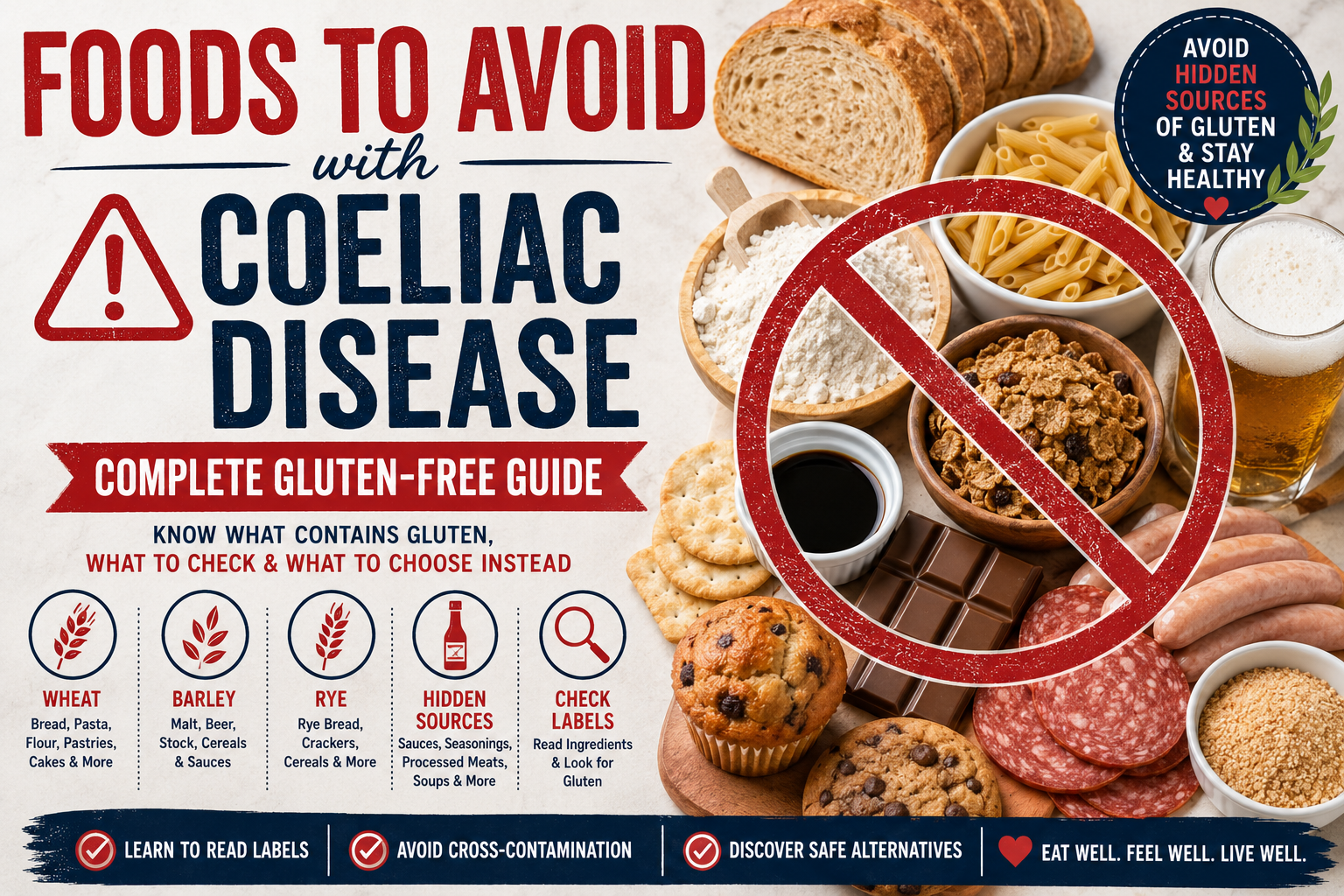
Being diagnosed with coeliac disease can leave you with one very big question:
What foods do I actually need to stop eating?
Most people already know that regular bread and pasta contain gluten, but unfortunately, gluten isn’t always that obvious.
It can also appear in sauces, breakfast cereals, processed meats, seasonings, stock, gravy, confectionery and many other everyday products.
Understanding the foods to avoid with coeliac disease is therefore about more than simply giving up bread.
You need to learn which grains contain gluten, which everyday foods are commonly made from those grains, where gluten can hide in processed foods and how cross-contact can turn an otherwise gluten-free food into something unsuitable.
That might sound overwhelming.
But it gets much easier.
Once you understand the main sources of gluten, you’ll start recognising them quickly when you’re shopping, cooking or eating away from home.
This guide will walk you through the major foods and ingredients to avoid, explain some of the less obvious sources of gluten and show you suitable alternatives so that your diet doesn’t feel unnecessarily restrictive.
Why Do People With Coeliac Disease Need to Avoid Gluten?
Coeliac disease is an autoimmune condition.
When someone with coeliac disease eats gluten, their immune system reacts and damages the lining of the small intestine.
The small intestine contains tiny finger-like structures called villi, which help the body absorb nutrients from food.
Damage to these structures can interfere with nutrient absorption.
For this reason, the treatment for coeliac disease is a strict gluten-free diet.
Importantly, you shouldn’t judge whether a food is safe based on whether it causes noticeable symptoms.
Some people experience obvious symptoms after eating gluten, while others may experience few or no immediate symptoms.
The Three Main Gluten-Containing Grains
The easiest place to begin is by remembering three grains:
Wheat
Barley
Rye
These are the major gluten-containing grains that people with coeliac disease need to recognise.
Unfortunately, they appear under many different names and are used in thousands of processed foods.
Let’s look at each one.
1. Wheat
Wheat is probably the most familiar source of gluten.
It is used to make many everyday foods, including:
- Bread
- Pasta
- Cakes
- Biscuits
- Crackers
- Pastries
- Pizza bases
- Breakfast cereals
- Noodles
- Breadcrumbs
- Flour tortillas
Regular wheat flour is also used as a thickener or ingredient in many processed foods.
Different Names for Wheat
Wheat doesn’t always appear simply as “wheat”.
Other wheat varieties and wheat-derived ingredients can include:
- Durum
- Semolina
- Spelt
- Bulgur
- Couscous
- Farina
- Einkorn
- Emmer
- Kamut/Khorasan wheat
If you’re newly diagnosed, these names can be confusing.
You don’t need to memorise everything immediately. With regular label reading, the common names quickly become familiar.
2. Barley
Barley contains gluten and needs to be avoided by people with coeliac disease.
Barley can appear in foods such as:
- Soups
- Cereals
- Malt products
- Beer
- Some stock products
- Some flavourings
One of the biggest things to watch for is malt.
Malt Is an Important Ingredient to Recognise
Malt is commonly made from barley.
You may see ingredients such as:
- Barley malt
- Malt extract
- Malt syrup
- Malt flavouring
- Malt vinegar
Malt can appear in products that don’t look anything like bread.
For example, it may be found in:
- Breakfast cereal
- Confectionery
- Drinks
- Sauces
- Vinegar
- Snack foods
If you’re newly diagnosed, malt is a useful word to learn early.
3. Rye
Rye also contains gluten.
It is commonly found in:
- Rye bread
- Rye flour
- Rye crackers
- Some cereals
- Some alcoholic drinks
Rye may be less common in your pantry than wheat, but it still needs to be avoided.
What About Spelt?
This is a common source of confusion.
Spelt is sometimes marketed as an ancient or alternative grain, which can make it sound like a gluten-free alternative.
It isn’t.
Spelt is a type of wheat and contains gluten.
Regular spelt bread, spelt flour and spelt pasta aren’t suitable for someone with coeliac disease.
What About Couscous?
Couscous looks a little like a grain such as rice or quinoa, but traditional couscous is usually made from wheat—commonly durum wheat or semolina.
That means regular couscous contains gluten.
Suitable gluten-free alternatives may include:
- Quinoa
- Rice
- Corn-based couscous alternatives
- Other products specifically labelled gluten free
What About Bulgur?
Bulgur is made from wheat.
It is commonly used in dishes such as tabbouleh.
Regular bulgur isn’t suitable for someone with coeliac disease.
Quinoa can be a useful gluten-free substitute in similar dishes.
4. Regular Bread
Regular bread is one of the most obvious foods to avoid with coeliac disease.
This includes most conventional:
- White bread
- Wholemeal bread
- Multigrain bread
- Sourdough
- Bread rolls
- Burger buns
- Hot dog buns
- Bagels
- Pita bread
- Flatbread
Fortunately, gluten-free versions of many of these products are now available.
What About Sourdough?
Traditional wheat sourdough still contains gluten.
Fermentation doesn’t automatically make wheat bread safe for someone with coeliac disease.
Choose bread specifically made and labelled appropriately for a gluten-free diet.
5. Regular Pasta
Traditional pasta is usually made from durum wheat or semolina.
This includes:
- Spaghetti
- Penne
- Macaroni
- Fettuccine
- Lasagne sheets
- Ravioli
- Tortellini
Fortunately, there are plenty of alternatives made from ingredients such as:
- Rice
- Corn
- Lentils
- Chickpeas
- Peas
- Gluten-free flour blends
Always check the individual product.
6. Regular Noodles
Many noodles contain wheat.
Examples can include:
- Ramen
- Udon
- Egg noodles
- Instant noodles
Rice noodles may be a useful alternative, but don’t assume they’re automatically suitable.
Check the ingredients and any accompanying flavour sachets or sauces.
7. Cakes
Most conventional cakes are made using wheat flour.
This includes many:
- Birthday cakes
- Cupcakes
- Sponge cakes
- Chocolate cakes
- Carrot cakes
- Fruit cakes
- Muffins
The good news is that almost all of these can be made with gluten-free flour instead.
If you’re buying from a bakery or café, also ask about cross-contact during preparation and display.
8. Biscuits and Cookies
Regular biscuits and cookies commonly contain wheat flour.
Examples include:
- Chocolate chip cookies
- Shortbread
- Digestive-style biscuits
- Sandwich biscuits
- Crackers
- Wafer biscuits
Choose versions specifically made with suitable gluten-free ingredients.
9. Pastries
Traditional pastry is generally made from wheat flour.
This means conventional:
- Pies
- Sausage rolls
- Croissants
- Danish pastries
- Tarts
- Puff pastry products
normally contain gluten.
Gluten-free pastry alternatives are available, and many of these foods can be recreated using gluten-free pastry.
10. Regular Pizza
Traditional pizza bases are made from wheat flour.
Choose a suitable gluten-free pizza base instead.
When ordering pizza from a restaurant, remember that the base isn’t the only consideration.
Potential cross-contact can occur from:
- Flour on preparation benches
- Shared utensils
- Shared pizza cutters
- Shared ovens or surfaces
If you have coeliac disease, ask how the restaurant prepares its gluten-free pizzas.
11. Breadcrumbs and Crumbed Foods
Traditional breadcrumbs are made from bread containing wheat.
That means many crumbed products contain gluten, including:
- Chicken schnitzel
- Chicken nuggets
- Fish fingers
- Crumbed fish
- Crumbed sausages
- Breaded vegetables
Suitable gluten-free breadcrumbs can be used instead.
12. Breakfast Cereals
Breakfast cereal is one of the less obvious areas where gluten appears.
Many cereals contain:
- Wheat
- Barley
- Malt
- Malt extract
Even a cereal made mainly from rice or corn may contain barley malt or another gluten-containing ingredient.
Don’t assume the cereal is suitable based only on its main grain.
Read the full label.
13. Flour
Regular flour made from wheat contains gluten.
This includes:
- Plain flour
- Self-raising flour
- Bread flour
- Wholemeal flour
- Cake flour
- Durum flour
- Semolina flour
- Spelt flour
Suitable alternatives can include:
- Rice flour
- Cornflour/cornstarch
- Tapioca starch
- Potato starch
- Buckwheat flour
- Almond flour
- Chickpea flour
- Gluten-free flour blends
Check packaging and suitability, particularly where cross-contact during processing is possible.
Flour Can Also Cause Cross-Contact
Loose wheat flour deserves special attention in a shared kitchen.
Fine flour particles can spread onto benches, equipment and uncovered food during baking.
If someone in your household regularly bakes with wheat flour, preparing gluten-free food at the same time can increase the risk of cross-contact.
Clean preparation areas thoroughly and keep gluten-free ingredients and food protected.
14. Crackers
Most regular crackers are made with wheat flour.
This can include:
- Water crackers
- Cream crackers
- Cheese crackers
- Wheat crackers
- Crispbreads
There are plenty of gluten-free alternatives made from rice, corn, seeds, legumes and gluten-free flour blends.
15. Beer
Traditional beer is usually made using barley and therefore contains gluten.
This can include:
- Lager
- Ale
- Stout
- Pilsner
- Wheat beer
Gluten-free beers are available.
Check the label carefully rather than assuming terms such as low gluten, gluten reduced, and gluten free are interchangeable, as standards and terminology can vary between countries.
16. Regular Soy Sauce
This one surprises a lot of people.
Traditional soy sauce commonly contains wheat.
That means soy sauce can introduce gluten into:
- Stir-fries
- Marinades
- Sushi
- Fried rice
- Dipping sauces
- Restaurant meals
Gluten-free soy sauce is available, and some tamari products are suitable.
However, always check the individual label.
17. Gravy
Traditional homemade gravy is often thickened with wheat flour.
Packet gravy products may also contain gluten-containing ingredients.
Choose a suitable gluten-free gravy or make your own using an appropriate gluten-free thickener.
This is particularly important at roast dinners, restaurants and family gatherings.
The meat itself may be perfectly gluten free while the gravy poured over it isn’t.
18. Some Soups
Soup isn’t automatically gluten free.
Packaged and restaurant soups can contain:
- Wheat flour
- Barley
- Pasta
- Noodles
- Stock containing gluten
- Thickeners
- Seasonings
Always check canned, packet and refrigerated soups.
When ordering soup at a restaurant, ask about both the ingredients and preparation.
The First Rule: Don’t Judge Food by Appearance
This is one of the most important lessons when learning about foods to avoid with coeliac disease.
You can look at two bowls of soup and have absolutely no idea which one contains gluten.
You can look at two sausages and not know whether one contains wheat.
You can look at two packets of potato chips and find that one is suitable while the other isn’t.
That’s why label reading is so important.
Instead of asking:
“Does this look gluten free?”
Get into the habit of asking:
“What are the ingredients, and how was it prepared?”
That one habit will make navigating a gluten-free diet considerably easier.
Coming Up in Part 2
In Part 2 we’ll get into the hidden foods to avoid with coeliac disease, including some of the products that catch newly diagnosed people out:
- Sausages
- Burger patties
- Processed meats
- Stock cubes
- Sauces
- Marinades
- Seasonings
- Salad dressings
- Potato chips
- Chocolate
- Lollies
- Ice cream
- Frozen foods
- Takeaways
- Restaurant meals
- Shared fryers
Foods to Avoid With Coeliac Disease — Part 2: Hidden Gluten in Everyday Foods
Some foods to avoid with coeliac disease are easy to recognise. You probably already know that regular bread, pasta, cakes and biscuits usually contain gluten.
The harder part is dealing with foods that don’t look as though they should contain gluten at all.
A sausage, bowl of soup, packet of chips or chocolate bar might contain gluten depending on the ingredients and how it was manufactured.
This doesn’t mean everyone with coeliac disease needs to avoid every processed food.
Instead, these are foods where you need to stop and check the label before deciding whether they’re suitable.
19. Sausages
Plain meat is naturally gluten free, but sausages are processed foods and recipes vary considerably.
Depending on the product, sausages may contain:
- Wheat-based fillers
- Breadcrumbs
- Seasoning mixes
- Sauces
- Other added ingredients
Some sausages are gluten free and others aren’t.
What Should You Do?
Check packaged sausages every time you buy them.
If you’re buying sausages from a butcher, ask about the ingredients and possible cross-contact during preparation.
20. Burger Patties
A homemade burger made from plain minced beef can be naturally gluten free.
Pre-made burger patties are different.
Manufacturers may add:
- Breadcrumbs
- Fillers
- Seasonings
- Sauces
- Flavourings
Don’t assume a burger patty is gluten free simply because it looks like plain meat.
Check the ingredients.
When eating out, you also need to consider the bun, sauces and how the burger is cooked.
21. Meatballs
Traditional meatball recipes frequently use breadcrumbs to help bind the mixture together.
Gluten-free meatballs can easily be made using suitable alternatives, but pre-made meatballs need to be checked.
This also applies to meatballs served in restaurants.
22. Deli and Processed Meats
Processed meat products can contain additional ingredients that require checking.
These can include:
- Ham
- Salami
- Luncheon meat
- Flavoured chicken
- Processed turkey
- Some bacon products
At a deli counter, there’s another potential issue: cross-contact.
Slicers, knives, boards and other equipment may be shared between different products.
If you have coeliac disease, ask staff about both the ingredients and how the food is handled.
23. Marinades
Marinated meat can look like an easy gluten-free dinner, but the marinade itself needs checking.
Marinades can contain ingredients such as:
- Soy sauce containing wheat
- Malt ingredients
- Sauces
- Seasoning mixes
Plain meat might be naturally gluten free, but once a marinade is added, you need to check again.
24. Stock Cubes and Stock Powders
Stock is one of those pantry staples that gets added to everything.
You may use it in:
- Soup
- Gravy
- Risotto
- Casseroles
- Stews
- Sauces
- Curries
Some stock products are suitable for a gluten-free diet and others aren’t.
Check:
- Stock cubes
- Stock powder
- Liquid stock
- Bouillon
- Flavoured stock products
Once you find a suitable product you like, keeping it as a regular pantry staple makes cooking much easier.
25. Sauces
Sauces are one of the most important product categories to check.
Gluten-containing ingredients may be used as thickeners, flavourings or components of other ingredients.
Check products such as:
- BBQ sauce
- Tomato sauce/ketchup
- Teriyaki sauce
- Oyster sauce
- Stir-fry sauce
- Curry sauce
- Pasta sauce
- Sweet chilli sauce
- Worcestershire sauce
There are plenty of gluten-free sauces available, so you don’t have to give up flavour.
The key is choosing the right product.
26. Salad Dressings
A salad made from lettuce, tomato, cucumber and chicken may look completely gluten free.
But what happens when you pour dressing over it?
Packaged salad dressings can contain numerous ingredients, so check them individually.
This includes:
- Caesar dressing
- Ranch-style dressing
- Vinaigrettes
- Creamy dressings
- Flavoured dressings
Restaurant salads can also contain croutons or other gluten-containing toppings.
27. Seasoning Mixes
Plain herbs and spices are naturally gluten free, but seasoning blends are processed products and should be checked.
Examples include:
- Taco seasoning
- Fajita seasoning
- BBQ rubs
- Chicken seasoning
- Meat seasoning
- Curry mixes
- Flavoured salt
- Seasoning sachets
Don’t assume something is safe simply because only a small amount is used.
28. Gravy Mixes
As we discussed in Part 1, traditional gravy may contain wheat flour.
Packet gravy mixes can also contain gluten-containing ingredients.
This is particularly easy to overlook at:
- Restaurants
- Cafés
- Roast dinners
- Christmas meals
- Family gatherings
Always ask if you’re unsure.
29. Potato Chips and Crisps
Potatoes themselves are naturally gluten free.
That doesn’t mean every packet of potato chips is.
Flavoured varieties can contain seasoning mixtures and other ingredients that require checking.
Examples include:
- Chicken-flavoured chips
- BBQ chips
- Cheese-flavoured chips
- Salt and vinegar chips
- Sour cream-flavoured chips
Some will be suitable and others won’t.
Read the individual label rather than assuming all products from the same brand are the same.
30. Frozen Chips and Fries
Again, potatoes aren’t the problem.
Frozen chips may have:
- Coatings
- Seasonings
- Added flavourings
Check the package before buying.
There is also another major issue when ordering chips from restaurants or takeaway shops: shared fryers.
If chips are cooked in the same oil as battered fish, chicken nuggets, onion rings or other gluten-containing foods, gluten can be transferred to the chips.
Ask whether a dedicated gluten-free fryer is used.
31. Hash Browns and Other Potato Products
Processed potato products should also be checked.
These can include:
- Hash browns
- Potato wedges
- Potato gems/tater tots
- Potato cakes
- Flavoured mashed potato
- Instant mashed potato
Some products are suitable while others contain coatings, seasonings or other ingredients.
32. Rice Crackers
Rice is naturally gluten free, so rice crackers might seem like an obvious safe choice.
Unfortunately, flavoured rice crackers can contain additional ingredients such as wheat-containing soy sauce or seasonings.
Always check the package.
The same principle applies to many foods:
The main ingredient being gluten free doesn’t automatically make the finished product gluten free.
33. Chocolate
Chocolate is another product where you can’t make a blanket rule.
Some chocolate may be suitable for a gluten-free diet.
Others contain obvious sources of gluten, including:
- Biscuit pieces
- Wafers
- Pretzels
- Malt
- Cookie pieces
- Cereal pieces
Check every product individually.
Also check seasonal varieties because a company’s Easter or Christmas products may have different ingredients or manufacturing information from its standard range.
34. Lollies, Candy and Sweets
Confectionery is another category where ingredients vary significantly.
Check products such as:
- Liquorice
- Gummy sweets
- Chewy sweets
- Chocolate-coated sweets
- Novelty confectionery
Watch Out for Liquorice
Liquorice is one product newly diagnosed people often don’t realise can contain wheat flour.
Always check the ingredients.
35. Ice Cream
Some ice cream products may be gluten free, but flavours containing additions such as these require particular attention:
- Cookies
- Brownies
- Cheesecake pieces
- Biscuit pieces
- Waffle cone
- Malt
There is also a potential cross-contact issue at ice cream shops.
The same scoop may move between different tubs and transfer crumbs from one flavour to another.
If you have coeliac disease, ask staff about their procedures.
36. Frozen Meals
A frozen meal that looks gluten free from the picture on the front isn’t necessarily safe.
For example:
Chicken + vegetables + rice
sounds naturally gluten free.
But the sauce could contain wheat-based ingredients or another source of gluten.
Check frozen:
- Curries
- Pasta meals
- Rice meals
- Meat dishes
- Frozen dinners
- Ready meals
Look beyond the main ingredients and read the entire label.
37. Soup
Soup deserves another mention because it can contain several hidden sources of gluten.
Potential ingredients include:
- Wheat flour
- Barley
- Pasta
- Noodles
- Stock
- Seasonings
- Thickeners
Even creamy vegetable soups may use wheat flour as a thickener.
Homemade soup can be much easier to control because you know exactly what has gone into it.
38. Sushi
Sushi is an excellent example of a meal that can look gluten free but isn’t necessarily gluten free.
Plain rice and fish don’t naturally contain gluten.
But sushi may include:
- Soy sauce containing wheat
- Teriyaki sauce
- Tempura
- Imitation seafood products
- Marinades
- Other sauces
Cross-contact during preparation is another consideration.
Ask before ordering rather than assuming all sushi is safe.
39. Takeaway Food
Takeaways can be challenging because you can’t see everything happening in the kitchen.
Foods to investigate include:
- Chips
- Burgers
- Pizza
- Fried chicken
- Fish
- Curries
- Chinese-style dishes
- Sushi
- Mexican-style food
This doesn’t mean you can never eat takeaway food.
It means you need to ask questions about both ingredients and preparation.
40. Restaurant Meals
A menu may identify a dish as gluten free, but someone with coeliac disease may still need to ask about cross-contact.
Useful questions include:
Is this suitable for someone with coeliac disease?
Is it prepared separately from gluten-containing food?
Are the chips cooked in a dedicated fryer?
Does the sauce contain wheat, barley, rye or malt?
Is gluten-free bread toasted separately?
Are clean utensils used?
A good restaurant should be willing to explain how it handles dietary requirements.
41. Buffets
Buffets can present a particularly high cross-contact risk.
Even if a dish starts out gluten free, customers can accidentally:
- Put the wrong spoon into it.
- Drop bread crumbs into it.
- Move utensils between dishes.
- Place gluten-containing food on the same serving surface.
If you’re attending a buffet, speak to staff about safe options rather than relying only on what a dish looks like.
42. Shared Fryers
A shared fryer deserves its own section because it’s such an easy source of accidental gluten exposure.
Imagine a restaurant frying:
- Battered fish
- Chicken nuggets
- Onion rings
- Plain chips
in the same oil.
The chips started as a naturally gluten-free food, but they have been cooked in oil containing particles from gluten-containing foods.
For someone with coeliac disease, ask whether fried food is prepared in a dedicated gluten-free fryer.
43. Shared Toasters
Putting gluten-free bread into a toaster that contains crumbs from regular bread can cause cross-contact.
A separate gluten-free toaster is one simple solution.
Some households also use appropriately designed toaster bags, depending on their circumstances.
44. Shared Spreads
This one happens incredibly easily.
Someone:
- Butters regular toast.
- Puts the crumb-covered knife back into the butter.
- Leaves crumbs in the container.
The same thing can happen with:
- Jam
- Peanut butter
- Marmalade
- Cream cheese
- Chocolate spread
Using dedicated gluten-free containers is an easy way to prevent this.
What Does “May Contain Wheat” Mean?
You may see precautionary statements such as:
“May contain wheat.”
“May contain gluten.”
“Made in a facility that also handles wheat.”
These warnings relate to the possibility of unintended allergen cross-contact during manufacturing rather than an ingredient intentionally added to the recipe.
This is one area where you should follow the food-labelling guidance applicable in your country.
If you’re unsure whether a particular product is suitable for your coeliac diet, check with your dietitian, national coeliac organisation or the manufacturer.
Wheat-Free Does NOT Mean Gluten Free
This distinction is extremely important.
A product labelled:
WHEAT FREE
isn’t automatically:
GLUTEN FREE.
Why?
Because gluten is also found in barley and rye.
A wheat-free product could still contain either of those grains.
Always read the full label.
“No Gluten Ingredients” Isn’t Necessarily the Same as “Gluten Free”
You may occasionally see informal statements online or on menus saying a product has “no gluten-containing ingredients.”
That doesn’t necessarily provide the same information as a regulated gluten-free claim.
Cross-contact during manufacturing or preparation may still be relevant.
For someone with coeliac disease, look for clear information about suitability rather than relying on vague wording.
Don’t Remove the Gluten and Eat the Rest
If gluten-containing food has already touched your meal, simply removing it isn’t an appropriate way to make the meal gluten free.
For example:
❌ Removing the regular bun from a burger.
❌ Picking croutons out of a salad.
❌ Scraping crumbs off food.
❌ Removing a biscuit from a dessert.
Gluten may already have transferred to the rest of the food.
The meal needs to be prepared gluten free from the beginning.
Don’t Rely on Symptoms
Another mistake is assuming:
“I ate it and didn’t feel sick, so it must have been safe.”
Coeliac disease doesn’t work that way.
People can have very different reactions to gluten, and the absence of noticeable symptoms doesn’t prove that gluten exposure hasn’t occurred.
This is why avoiding known gluten exposure matters even if you don’t experience an obvious reaction.
Coming Up in Part 3
In the final section we’ll turn everything into an easy reference guide with:
- Foods to Avoid With Coeliac Disease checklist
- Foods that are naturally gluten free
- Foods you should always check
- Gluten-free alternatives
- Kitchen cross-contact checklist
- Restaurant checklist
- Common beginner mistakes
- Frequently asked questions
- Key takeaways
- Trusted coeliac resources
- Medical disclaimer
Foods to Avoid With Coeliac Disease: Complete Checklist
If you’ve recently been diagnosed, don’t feel as though you need to memorise this entire list immediately.
The most important starting point is remembering:
Wheat. Barley. Rye.
Then learn to read food labels and recognise the processed foods where these ingredients can hide.
Foods That Normally Contain Gluten
Unless they’re specifically made with suitable gluten-free ingredients, avoid regular versions of:
- Wheat bread
- Bread rolls
- Burger buns
- Bagels
- Pita bread
- Wheat-based wraps
- Wheat sourdough
- Pasta
- Wheat noodles
- Couscous
- Bulgur
- Cakes
- Cupcakes
- Muffins
- Biscuits
- Cookies
- Crackers
- Pastries
- Croissants
- Pies
- Sausage rolls
- Pizza bases
- Breadcrumbs
- Crumbed chicken
- Battered fish
- Wheat-based breakfast cereals
- Traditional barley-based beer
The good news is that gluten-free alternatives are available for many of these foods.
Gluten-Containing Ingredients to Recognise
When you’re reading food labels, watch for ingredients such as:
- Wheat
- Barley
- Rye
- Spelt
- Durum
- Semolina
- Bulgur
- Couscous
- Einkorn
- Emmer
- Khorasan wheat/Kamut
- Barley malt
- Malt extract
- Malt syrup
- Malt flavouring
Some ingredient terminology and labelling requirements vary between countries, so follow the food-labelling guidance where you live.
Foods You Should Always Check
This category is extremely important.
These foods aren’t automatically unsafe.
Instead, some versions may be gluten free while others contain gluten.
Always check:
- Sausages
- Burger patties
- Meatballs
- Deli meats
- Marinated meat
- Stock cubes
- Stock powders
- Gravy
- Soup
- Soy sauce
- Stir-fry sauces
- Teriyaki sauce
- BBQ sauce
- Worcestershire sauce
- Salad dressings
- Seasoning mixes
- Potato chips
- Frozen chips
- Hash browns
- Rice crackers
- Breakfast cereals
- Chocolate
- Lollies/candy
- Ice cream
- Frozen meals
- Flavoured dairy products
- Protein bars
- Snack bars
- Flavoured drinks
- Premixed alcoholic drinks
The key word here is check, not necessarily avoid.
You don’t want to unnecessarily remove foods from your diet when a suitable gluten-free version may be available.
Foods That Are Naturally Gluten Free
After reading such a long list of foods containing gluten, it’s important to remember how much food remains available.
Plain, unprocessed examples include:
Fruit
- Apples
- Bananas
- Berries
- Grapes
- Kiwifruit
- Oranges
- Pears
- Peaches
- Plums
- Mangoes
- Melons
Vegetables
- Potatoes
- Kumara/sweet potato
- Carrots
- Pumpkin
- Broccoli
- Cauliflower
- Spinach
- Tomatoes
- Capsicum/peppers
- Corn
- Peas
- Green beans
Protein
- Plain beef
- Plain chicken
- Plain lamb
- Plain pork
- Fresh fish
- Seafood
- Eggs
- Beans
- Lentils
- Chickpeas
Dairy
Many plain varieties of:
- Milk
- Butter
- Cream
- Cheese
- Natural yoghurt
are naturally gluten free.
Naturally Gluten-Free Staples
- Rice
- Corn/maize
- Quinoa
- Buckwheat
- Millet
- Sorghum
- Amaranth
- Polenta
- Nuts
- Seeds
Processed or packaged versions should still be checked where appropriate.
Easy Gluten-Free Swaps
One of the easiest ways to adjust after diagnosis is to stop thinking:
“I can’t eat that anymore.”
Instead ask:
“What’s the gluten-free version?”
Here are some simple swaps.
Instead of Regular Bread
Choose suitable gluten-free bread.
Instead of Wheat Pasta
Choose gluten-free pasta made from rice, corn, lentils, chickpeas or another suitable ingredient.
Instead of Wheat Flour
Use a gluten-free flour blend or an appropriate naturally gluten-free flour.
Instead of Regular Soy Sauce
Choose a suitable gluten-free soy sauce or gluten-free-labelled tamari.
Instead of Regular Breadcrumbs
Use gluten-free breadcrumbs.
Instead of Regular Crackers
Choose suitable gluten-free crackers.
Instead of Regular Pizza
Use a gluten-free pizza base prepared without gluten cross-contact.
Instead of Regular Cake
Make or buy cake prepared with suitable gluten-free ingredients.
A coeliac diagnosis changes which version of many foods you eat. It doesn’t necessarily mean giving them up completely.
Kitchen Cross-Contact Checklist
Avoiding gluten-containing ingredients is only part of managing coeliac disease.
Your gluten-free food also needs to stay gluten free during preparation.
Pay particular attention to:
Toasters
Regular bread leaves crumbs behind. Consider a dedicated gluten-free toaster or another method that prevents contact with crumbs.
Chopping Boards
Use thoroughly cleaned equipment and consider keeping a dedicated board for gluten-free preparation, particularly where surfaces are difficult to clean.
Colanders
Pasta residue can become trapped in holes and crevices. A dedicated gluten-free colander can make things easier.
Butter and Spreads
Regular bread crumbs can contaminate shared butter, jam and other spreads.
Fryers
Oil used for battered or crumbed foods shouldn’t be assumed safe for gluten-free fried food.
Benches
Clean food-preparation surfaces before preparing gluten-free meals.
Utensils
Use clean knives, spoons, tongs and other cooking equipment.
Eating Out Checklist
Eating at restaurants can still be part of life with coeliac disease.
Before ordering, consider asking:
- Is this suitable for someone with coeliac disease?
- What ingredients are used?
- Is the food prepared separately?
- Is there a shared fryer?
- Is gluten-free bread toasted separately?
- Does the sauce contain gluten?
- Are clean utensils used?
- Could flour or crumbs come into contact with the meal?
If staff aren’t able to answer your questions confidently, choosing something else may be the safer option.
Common Mistakes After a Coeliac Disease Diagnosis
Learning a gluten-free diet takes time.
Here are some common beginner mistakes to watch for.
Mistake 1: Only Avoiding Bread
Gluten isn’t only found in bread.
It can also appear in sauces, cereals, seasonings, processed meats, confectionery and many other products.
Mistake 2: Thinking Wheat-Free Means Gluten Free
A wheat-free product could still contain barley or rye.
Always check the full ingredients list.
Mistake 3: Assuming Rice or Corn Products Are Automatically Safe
Rice and corn are naturally gluten free, but processed products made from them can contain other ingredients.
Check flavoured rice crackers, corn chips, cereals and similar foods.
Mistake 4: Forgetting About Drinks
Some drinks contain malt or other ingredients that require checking.
Traditional barley-based beer is an obvious example.
Mistake 5: Ignoring Cross-Contact
Buying gluten-free bread doesn’t help if it’s then covered in crumbs from a shared toaster.
Think about both the ingredients and preparation.
Mistake 6: Trusting a Product Forever
Manufacturers can change recipes.
A product you’ve bought many times before should still be checked periodically, particularly if its packaging or formulation changes.
Mistake 7: Assuming “I Didn’t Feel Sick” Means It Was Safe
Some people with coeliac disease experience obvious symptoms after gluten exposure.
Others may experience few or no immediate symptoms.
Symptoms aren’t a reliable way to determine whether a food contained gluten.
Frequently Asked Questions
What Are the Main Foods to Avoid With Coeliac Disease?
Foods containing wheat, barley or rye need to be avoided.
This includes regular versions of bread, pasta, cakes, biscuits, pastries and many cereals, along with less obvious foods containing gluten-derived ingredients.
Can People With Coeliac Disease Eat Wheat?
No. Wheat contains gluten.
This includes varieties such as spelt, durum, semolina, einkorn, emmer and Khorasan wheat.
Can People With Coeliac Disease Eat Barley?
No. Barley contains gluten.
This includes barley-derived malt ingredients that aren’t suitable under applicable gluten-free standards.
Can People With Coeliac Disease Eat Rye?
No. Rye contains gluten.
Can People With Coeliac Disease Eat Spelt?
No.
Spelt is a form of wheat and contains gluten.
Can People With Coeliac Disease Eat Sourdough?
Regular wheat-based sourdough isn’t considered gluten free simply because it has been fermented.
Choose sourdough specifically made with suitable gluten-free ingredients and prepared appropriately.
Can People With Coeliac Disease Eat Couscous?
Traditional couscous is generally made from wheat and isn’t gluten free.
Gluten-free alternatives are available.
Can People With Coeliac Disease Eat Chips?
Potentially.
Plain potatoes are naturally gluten free, but packaged chips can contain seasonings or coatings that require checking.
Restaurant chips may also be cooked in a fryer shared with battered or crumbed foods.
Can People With Coeliac Disease Eat Chocolate?
Some chocolate may be suitable.
Products containing biscuit pieces, wafers, malt, pretzels or other gluten-containing ingredients aren’t suitable.
Check each product individually.
Can People With Coeliac Disease Drink Beer?
Traditional beer is commonly made from barley and contains gluten.
Gluten-free beer products are available.
What Happens if Someone With Coeliac Disease Accidentally Eats Gluten?
Responses vary.
Some people may experience digestive symptoms, fatigue or other symptoms, while others may notice little immediately.
If accidental exposure happens, return to your normal gluten-free diet. Seek medical advice if you’re concerned about your symptoms or they’re severe or persistent.
The Three-Category Rule
When you’re unsure about a food, try placing it into one of these three categories.
🔴 Avoid
Foods clearly containing wheat, barley, rye or another unsuitable gluten-containing ingredient.
Examples:
- Regular bread
- Wheat pasta
- Regular biscuits
- Barley
- Rye bread
🟠 Check
Processed foods where ingredients vary.
Examples:
- Sausages
- Sauces
- Chips
- Chocolate
- Soup
- Ice cream
- Stock
🟢 Naturally Gluten Free
Plain foods that don’t naturally contain gluten.
Examples:
- Fruit
- Vegetables
- Plain meat
- Fish
- Eggs
- Rice
- Potatoes
This approach is much easier than trying to memorise every food in the supermarket.
Key Takeaways
When learning about foods to avoid with coeliac disease, remember these key points:
- Avoid wheat, barley and rye.
- Learn to recognise less obvious names for gluten-containing grains.
- Regular bread, pasta, cakes, biscuits and pastries generally need gluten-free replacements.
- Check processed foods carefully.
- Wheat-free doesn’t necessarily mean gluten free.
- Don’t assume a naturally gluten-free main ingredient makes the finished product safe.
- Consider cross-contact during cooking and preparation.
- Read food labels regularly.
- Ask questions when eating away from home.
- Choose suitable gluten-free alternatives rather than unnecessarily restricting your diet.
Final Thoughts
Seeing a long list of foods to avoid with coeliac disease can make a gluten-free diet seem incredibly restrictive.
But that’s only half of the picture.
Yes, regular wheat bread contains gluten.
But gluten-free bread exists.
Regular pasta contains wheat.
But there are gluten-free pastas made from rice, corn, lentils, chickpeas and other ingredients.
Traditional cakes contain wheat flour.
But you can make delicious cakes with suitable gluten-free flour.
And huge categories of food—including fresh fruit, vegetables, plain meat, fish, eggs, rice and potatoes—don’t naturally contain gluten at all.
The goal isn’t to spend your life focusing on everything you’re forbidden to eat.
It’s to learn which ingredients aren’t suitable, recognise foods that require checking, prevent cross-contact and discover safe alternatives you genuinely enjoy.
Shopping and cooking may take longer at first.
But with practice, checking labels and recognising gluten-containing foods becomes part of your normal routine.
Eventually, you’ll spend much less time thinking:
“Can I eat this?”
because you’ll have the knowledge and confidence to work out the answer.
Related Gluten-Free Guides
Foods You Can Eat With Coeliac Disease: Complete Gluten-Free Food List
How to Get Diagnosed With Coeliac Disease: Symptoms, Testing & Where to Get Help
Common Hidden Sources of Gluten: Foods, Drinks & Everyday Products to Watch Out For
How to Read Gluten-Free Food Labels: A Beginner’s Guide
How to Avoid Gluten Cross-Contamination With Coeliac Disease
The Ultimate Gluten-Free Shopping Guide
Trusted Resources
For up-to-date information about coeliac disease and gluten-free diets, consult reputable health and coeliac organisations, including:
- Coeliac New Zealand – https://coeliac.org.nz
- Health New Zealand | Te Whatu Ora – https://www.tewhatuora.govt.nz
- Coeliac Australia – https://www.coeliac.org.au
- Coeliac UK – https://www.coeliac.org.uk
- Celiac Disease Foundation – https://celiac.org
- Beyond Celiac – https://www.beyondceliac.org
- Canadian Celiac Association – https://www.celiac.ca
Food-labelling laws and some dietary recommendations differ between countries, so follow the guidance applicable where you live.
Medical Disclaimer
This article provides general educational information and isn’t a substitute for medical advice, diagnosis or personalised dietary advice. If you have coeliac disease, think you may have coeliac disease, or have questions about following a gluten-free diet, speak with your doctor or an appropriately qualified dietitian.
Leave a Reply
You must be logged in to post a comment.