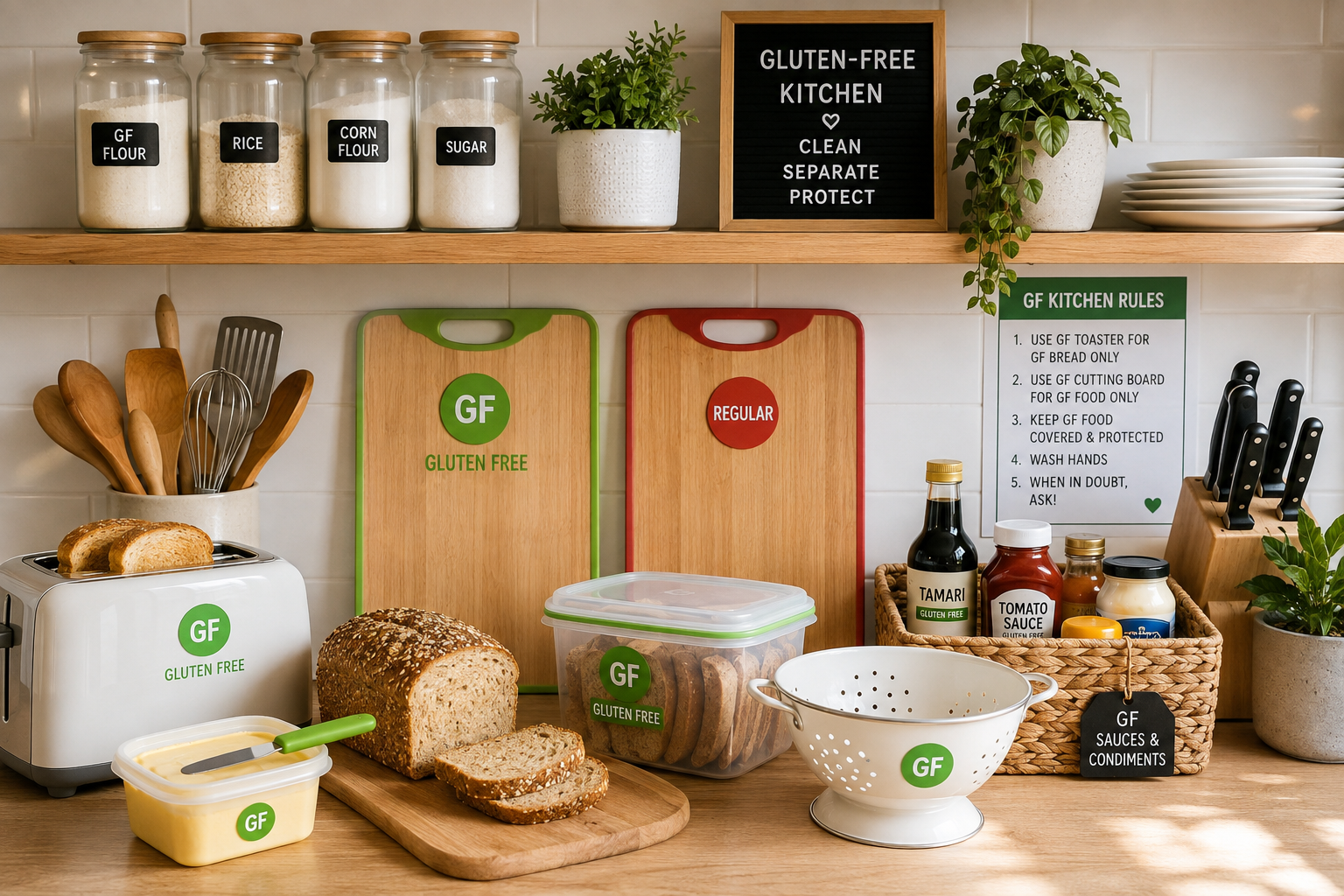
When you’re diagnosed with coeliac disease, one of the first places you may look at differently is your kitchen.
Suddenly, things you’ve never thought twice about can raise questions.
Can I still use my pots and pans?
Do I need a new toaster?
What about the air fryer?
Can my family continue eating normal bread?
Do I have to replace my wooden spoons?
Can gluten-free and regular food be stored in the same pantry?
And perhaps the most frightening question:
Do I need to throw away half my kitchen?
Thankfully, creating a gluten free kitchen setup doesn’t usually mean buying everything again.
The goal is to prevent gluten-containing food, crumbs and residue from coming into contact with the food of someone with coeliac disease.
Some kitchen items can simply be cleaned thoroughly.
Some are easier to dedicate to gluten-free cooking.
And some—particularly appliances that trap crumbs—deserve extra attention.
This guide will take you through your kitchen one area at a time so you can decide what to replace, clean, separate or keep.
Why Does Your Kitchen Setup Matter With Coeliac Disease?
Coeliac disease is an autoimmune condition triggered by gluten.
The treatment is a strict gluten-free diet.
That means you need to think about more than whether the ingredients in your meal contain gluten.
You also need to consider whether your gluten-free food has come into contact with gluten during:
- Storage
- Preparation
- Cooking
- Serving
This is generally referred to as cross-contact or sometimes cross-contamination.
For example, imagine you buy a loaf of gluten-free bread.
The bread itself is gluten free.
You put it into a toaster containing crumbs from wheat bread.
Then you spread butter on it from a container containing regular bread crumbs.
Your gluten-free bread has now come into contact with gluten.
That’s why a good kitchen setup can make managing coeliac disease much easier.
Coeliac New Zealand provides information and resources about living gluten free and managing coeliac disease.
Do You Need a Completely Gluten-Free Kitchen?
Not necessarily.
Many people with coeliac disease live with partners, children, flatmates or family members who continue to eat gluten.
A shared kitchen can be managed, but you need clear systems to reduce cross-contact.
For example, your household might have:
Regular bread + gluten-free bread
Regular pasta + gluten-free pasta
Regular biscuits + gluten-free biscuits
You don’t necessarily need two kitchens.
Instead, you need to think about:
Storage + preparation + equipment + cleaning.
Option 1: Make the Whole Kitchen Gluten Free
For some households, this is the easiest solution.
If everyone is happy eating gluten free at home, removing most or all gluten-containing products greatly simplifies food preparation.
You don’t have to worry as much about:
- Bread crumbs
- Shared butter
- Regular pasta
- Wheat flour
- Mixing up utensils
- Accidentally using the wrong product
However, making an entire household gluten free isn’t practical or necessary for every family.
Gluten-free specialty products can also be considerably more expensive.
Option 2: Create a Shared Kitchen
This is what many households choose.
Both gluten-free and gluten-containing foods remain in the home.
The important part is creating rules everyone understands.
For example:
Gluten-free toaster = gluten-free bread only.
Gluten-free butter = no regular bread knives.
Gluten-free chopping board = no wheat bread.
Once these habits become routine, a shared kitchen becomes much easier to manage.
Start With Your Pantry
Your pantry is a good place to begin your gluten free kitchen setup.
You don’t necessarily need to throw everything away.
Instead, work through your food and divide it into three groups.
Group 1: Naturally Gluten-Free Foods
You may be surprised by how much you can keep.
Examples can include plain:
- Rice
- Corn
- Beans
- Lentils
- Chickpeas
- Nuts
- Seeds
- Canned tomatoes
- Fruit
- Vegetables
Always check packaged products where appropriate, but many basic pantry staples don’t naturally contain gluten.
Group 2: Foods That Clearly Contain Gluten
This might include regular:
- Wheat flour
- Bread
- Pasta
- Biscuits
- Crackers
- Cakes
- Breadcrumbs
- Couscous
- Wheat noodles
If you’re creating a completely gluten-free household, these can be removed.
If you’re maintaining a shared kitchen, store them separately from gluten-free foods.
Group 3: Foods You Need to Check
This will probably be the biggest pile.
Check:
- Stock
- Gravy
- Sauces
- Soy sauce
- Marinades
- Seasonings
- Breakfast cereals
- Soup
- Chips
- Chocolate
- Snack foods
- Processed meat
- Baking ingredients
Don’t automatically throw these away.
Read the label first.
You may discover that plenty of products you already use are suitable.
Create a Dedicated Gluten-Free Pantry Area
In a shared household, one of the easiest changes is creating a dedicated gluten-free area.
This might be:
- One shelf
- One cupboard
- Several labelled containers
- A particular pantry section
Keep your frequently used gluten-free products together.
For example:
GLUTEN-FREE SHELF
- Bread
- Pasta
- Crackers
- Cereal
- Flour
- Baking ingredients
- Snacks
This makes it much harder for products to become mixed up.
It also makes shopping easier because you can quickly see what you’re running low on.
Store Gluten-Free Food Above Gluten-Containing Food
Where practical, keep gluten-free food above loose gluten-containing products.
Imagine this setup:
Top shelf: Gluten-free flour
Bottom shelf: Wheat flour
If wheat flour spills, gravity works in your favour.
Now imagine they’re reversed.
A torn bag of wheat flour could spill onto your gluten-free products below.
This is particularly important for loose ingredients such as flour.
Wheat Flour Deserves Special Attention
Regular wheat flour can spread much more easily than a slice of bread.
Pouring, mixing and baking with flour can leave it on:
- Benches
- Appliances
- Utensils
- Cupboard handles
- Floors
- Nearby ingredients
If your household continues using wheat flour, keep it in a securely closed container and away from gluten-free ingredients.
After baking with wheat flour:
- Clean the work surface.
- Clean equipment.
- Wash your hands.
- Remove visible flour residue before preparing gluten-free food.
Avoid preparing uncovered gluten-free food directly beside someone working with loose wheat flour.
Should Gluten-Free Flour Have Its Own Containers?
This is a very useful idea.
Keep gluten-free:
- Flour
- Cornflour/cornstarch where suitable
- Baking powder
- Baking soda
- Sugar used during baking
- Other baking ingredients
protected from regular flour.
Why include something like sugar?
Imagine someone measures wheat flour with a spoon and then puts that same spoon into the sugar container.
The sugar itself started gluten free, but gluten-containing flour may have been introduced.
Dedicated baking ingredients can prevent this.
Don’t Forget the Fridge
The fridge can also become a source of crumbs.
You don’t necessarily need a separate refrigerator.
Instead, think about how food is stored.
Keep gluten-free food:
- Covered
- Wrapped
- In containers
- Away from loose crumbs
If practical, give gluten-free food its own shelf or section.
The Shared Butter Problem
This deserves special attention because it happens so easily.
Someone makes regular toast.
They put their knife into the butter.
Spread it on their toast.
Then put the knife back into the butter.
Now you can see little crumbs floating around inside.
That butter is no longer something you want to spread onto gluten-free bread.
The same problem can happen with:
- Jam
- Peanut butter
- Marmalade
- Cream cheese
- Mayonnaise
- Chocolate spread
Easy Solutions for Shared Spreads
You have several options.
Option 1: Separate Containers
Have:
Regular butter
and
Gluten-free butter
Put a large GF label on the gluten-free container.
Option 2: Squeeze Bottles
Where suitable products are available, squeeze containers can prevent knives from being repeatedly dipped into the food.
Option 3: Household Rule
Everyone uses a completely clean utensil every time.
In practice, dedicated containers are often simpler—especially with children in the house.
Do You Need New Plates and Bowls?
Usually, ordinary plates and bowls that can be thoroughly washed don’t need to be replaced just because they’ve previously held gluten-containing food.
Clean them properly before using them for gluten-free food.
The same applies to many:
- Glasses
- Cups
- Metal utensils
- Ceramic dishes
- Stainless-steel equipment
You don’t need to panic and buy an entirely new dinner set.
What About Cutlery?
Regular metal:
- Forks
- Knives
- Spoons
can generally be thoroughly washed.
Make sure there’s no food residue remaining before they’re used with gluten-free food.
The bigger problem isn’t usually the knife itself.
It’s what happens when a crumb-covered knife goes back into a shared container.
Do You Need New Pots?
For ordinary smooth pots that can be thoroughly cleaned, replacement generally isn’t necessary simply because gluten-containing food was previously cooked in them.
Wash them carefully and remove food residue.
Pay additional attention to equipment that is:
- Heavily scratched
- Damaged
- Difficult to clean
- Covered in baked-on residue
If something can’t be adequately cleaned, replacing it may be the simpler solution.
What About Frying Pans?
The same general principle applies.
A smooth pan that can be thoroughly cleaned doesn’t automatically need replacing.
However, heavily damaged surfaces and areas that trap old food deserve attention.
If you aren’t confident an item can be cleaned properly, consider dedicating it to gluten-containing food or replacing it.
Stainless Steel Cookware
Stainless steel is generally straightforward to clean because it has a hard, non-porous surface.
Remove any cooked-on food and wash thoroughly.
There’s generally no reason to throw away good stainless-steel cookware simply because you used it to cook wheat pasta in the past.
What About Baking Trays?
Baking trays can be more complicated when they’re:
- Heavily scratched
- Covered in baked-on residue
- Difficult to clean around edges
If your tray is smooth and can be thoroughly cleaned, that’s different from an old tray with years of baked-on food.
You can also use clean baking paper or suitable liners where appropriate to create a clean preparation surface.
Do You Need Separate Mixing Bowls?
Smooth glass, metal or suitable plastic mixing bowls that can be thoroughly cleaned don’t generally need replacing.
However, check:
- Scratches
- Seams
- Cracks
- Difficult-to-clean areas
A clean bowl is the goal.
The Toaster Is Different
Now we’ve reached one of the pieces of equipment where sharing becomes much more difficult.
A conventional toaster is full of crumbs.
You can’t simply wipe the cooking surface between slices of bread.
Regular wheat bread can leave crumbs throughout the appliance.
For a household managing coeliac disease, a dedicated gluten-free toaster is one of the simplest solutions.
Buy a Gluten-Free Toaster
It doesn’t need to be expensive.
The important thing is making sure nobody puts regular bread into it.
Label it clearly:
GLUTEN FREE ONLY
If you have children, make the difference obvious.
For example, you might have:
Silver toaster = regular
White toaster = gluten free
The exact system doesn’t matter.
Consistency does.
What if You Don’t Have Space for Two Toasters?
Some households don’t have enough bench space for two appliances.
Alternatives may include appropriate toaster bags designed to prevent contact with crumbs, or using another clean cooking method.
Check that whatever method you choose genuinely prevents your food from contacting gluten residue.
For personalised advice about your kitchen setup, a dietitian experienced with coeliac disease can help.
What About a Sandwich Press?
Sandwich presses can accumulate crumbs and cooked-on food in:
- Hinges
- Grooves
- Plates
- Edges
If it’s regularly used for wheat bread, simply brushing away the visible crumbs may not be enough.
Options include:
- Keeping a separate gluten-free sandwich press.
- Using an appropriate barrier that completely protects the gluten-free food.
- Thoroughly cleaning removable cooking surfaces where the appliance allows.
A cheap dedicated sandwich press can sometimes be easier than worrying about it every time you make lunch.
Chopping Boards Need Attention
Chopping boards are another common question.
A board that’s used to slice regular bread can become covered in crumbs.
Older boards can also have deep knife marks where food residue becomes difficult to remove.
A simple solution is to buy a dedicated gluten-free chopping board.
Again, label it:
GF ONLY
They’re relatively inexpensive and remove another source of uncertainty.
What About Wooden Chopping Boards?
Wooden boards can develop grooves and scratches over time.
If an old wooden board has been heavily used for bread and other gluten-containing foods and is difficult to clean thoroughly, using a dedicated gluten-free board may be easier.
You don’t need an expensive one.
The important thing is having a clean preparation surface.
Wooden Spoons and Utensils
Wooden spoons can also become worn, cracked and difficult to clean thoroughly.
If yours are old and heavily used for gluten-containing cooking, you may prefer to replace them or keep dedicated gluten-free utensils.
Easy-to-clean materials such as:
- Metal
- Silicone
can make a shared kitchen simpler.
What About Plastic Utensils?
Inspect them.
Smooth plastic utensils that can be thoroughly cleaned are different from old utensils covered in:
- Deep scratches
- Cracks
- Damaged surfaces
You don’t need to replace things just because they’re plastic.
The question remains:
Can I clean this properly?
The Colander Problem
Colanders are another item many people with coeliac disease choose to keep separate.
Think about what happens when you drain regular wheat pasta.
Pasta residue can become trapped around:
- Holes
- Seams
- Handles
- Edges
A basic colander isn’t expensive, so having one labelled GLUTEN FREE can be an easy solution.
It also prevents someone accidentally draining regular pasta through the same one.
The Golden Rule: Replace, Separate, Clean or Keep?
As you work through your gluten free kitchen setup, ask four questions.
1. Can It Be Thoroughly Cleaned?
If yes, you may be able to keep sharing it.
2. Does It Trap Crumbs?
If yes, consider keeping a dedicated gluten-free version.
3. Is It Heavily Scratched or Damaged?
If food residue can’t be removed reliably, replacement or separation may be sensible.
4. Would Having a Separate One Make Life Easier?
Sometimes something technically can be cleaned, but doing so every single day creates unnecessary stress.
A $10 chopping board marked GF might be worth it simply because you don’t have to think about it again.
You Don’t Need to Create a Sterile Kitchen
It’s easy to become frightened of your kitchen when you’re first learning about gluten cross-contact.
The goal isn’t to make your house feel like a laboratory.
It’s to create simple, repeatable habits that protect gluten-free food.
A dedicated toaster.
A gluten-free pantry shelf.
Separate butter.
A clean preparation area.
A few clearly labelled utensils.
These relatively small changes can make a shared kitchen much easier to manage.
Coming Up in Part 2
In Part 2 of Gluten-Free Kitchen Setup for Coeliac Disease, we’ll tackle the appliances and cooking situations that create the most questions:
- Can coeliacs share an oven?
- Fan-forced ovens
- Air fryers
- Microwaves
- BBQs
- Slow cookers
- Rice cookers
- Deep fryers
- Shared cooking oil
- Dishwashers
- Sponges and dishcloths
- Cleaning benches properly
- Baking with wheat flour in a shared kitchen
- Preparing gluten-free and regular meals together
- Kids making toast and sandwiches
- Having visitors in your gluten-free kitchen
- Setting up a gluten-free baking area
Then in Part 3, we’ll create a room-by-room kitchen checklist and shopping list, including what you probably need to buy and what you probably don’t need to waste money replacing.
Gluten-Free Kitchen Setup for Coeliac Disease: Part 2
In Part 1, we worked through your pantry, food storage, shared spreads, cookware, chopping boards, toasters and utensils.
Now it’s time to tackle some of the biggest questions people have when creating a gluten free kitchen setup:
Can I share an oven?
Do I need another air fryer?
Can we use the same microwave?
What about the BBQ?
Do I need separate dishcloths and sponges?
A shared kitchen doesn’t need to become complicated. The aim is to identify where gluten-containing crumbs and residue can realistically reach your food and put simple systems in place to prevent it.
Can People With Coeliac Disease Share an Oven?
In many households, a separate oven isn’t necessary.
The important issue is preventing gluten-containing food, crumbs or loose flour from coming into contact with your gluten-free food.
Some practical precautions include:
- Use clean trays and baking dishes.
- Remove visible crumbs and spills.
- Keep gluten-free food away from gluten-containing food.
- Don’t place gluten-free food directly onto a contaminated oven rack.
- Use clean baking paper or appropriate clean trays where needed.
- Avoid preparing uncovered gluten-free food around loose wheat flour.
You certainly don’t need to rush out and buy a second oven simply because someone in your household has coeliac disease.
For individual advice, especially if your household does a lot of wheat-based baking, talk with a dietitian experienced in coeliac disease.
What About Fan-Forced Ovens?
Fan-forced ovens are a common concern.
The bigger practical issue is loose flour and crumbs rather than simply the fact that an oven has previously cooked food containing gluten.
For example, don’t prepare an uncovered gluten-free meal beside someone throwing wheat flour around while making bread.
When using a shared oven:
- Keep the oven reasonably clean.
- Remove visible crumbs.
- Use clean cookware.
- Keep food protected where appropriate.
- Avoid situations where gluten-containing food can drip or fall onto gluten-free food.
If you’re cooking gluten-containing and gluten-free foods at the same time, position foods so crumbs or drips can’t fall onto the gluten-free meal.
Can You Share a Microwave?
A microwave is generally much easier to manage than a toaster.
You can wipe down:
- The turntable
- Interior surfaces
- Door
- Handle
and remove visible food residue.
Prepare gluten-free food on a clean plate or in a clean container.
Covering food can also protect it from splashes.
You don’t generally need a dedicated microwave solely because you have coeliac disease.
What About an Air Fryer?
Air fryers require more thought.
Unlike a microwave, an air fryer circulates hot air around food and often has:
- Baskets
- Mesh
- Fans
- Grooves
- Seams
- Heating elements
Crumbs from foods such as regular:
- Chicken nuggets
- Crumbed fish
- Schnitzel
- Onion rings
- Breaded chicken
can collect inside the appliance.
If your household regularly cooks gluten-containing crumbed foods in the air fryer, having a dedicated gluten-free air fryer can be a practical option.
This is particularly useful if the appliance has areas that are difficult to clean thoroughly.
What if I Can’t Afford Another Air Fryer?
Don’t panic.
You don’t need to immediately purchase every appliance twice.
You could choose not to cook gluten-containing crumbed foods in the air fryer.
For example, your household might decide:
Air fryer = gluten-free cooking only.
Regular crumbed foods can be cooked another way.
That gives you one safe appliance without buying another one.
This is a useful principle throughout the kitchen:
Sometimes changing how you use something is cheaper than replacing it.
What About a Deep Fryer?
Deep fryers are a major cross-contact consideration.
If the same cooking oil is used for:
- Battered fish
- Regular chicken nuggets
- Crumbed chicken
- Onion rings
and then gluten-free chips are added, the chips have been exposed to gluten-containing food.
For a gluten-free fryer, both the fryer and cooking oil need to be managed appropriately.
This is also why asking about a dedicated gluten-free fryer is so important when eating at restaurants.
Can You Share Cooking Oil?
Consider what has already been cooked in it.
Oil used only for suitable gluten-free foods is different from oil that has been used to fry battered or crumbed gluten-containing food.
Don’t reuse oil from gluten-containing fried food for gluten-free cooking.
What About a BBQ?
A BBQ can be shared, but preparation matters.
The cooking surface may contain:
- Marinade residue
- Sauce
- Bread crumbs
- Pieces of food
Before preparing gluten-free food, clean the cooking surface appropriately.
Also use clean:
- Tongs
- Plates
- Utensils
Don’t cook gluten-free meat and then put it back onto the same plate that held gluten-containing food.
Watch the BBQ Sauces and Marinades
Sometimes the grill isn’t the biggest issue.
The food itself might have been marinated in a sauce containing gluten.
Check:
- BBQ sauces
- Soy sauce
- Marinades
- Seasoning blends
- Sausages
- Burger patties
Plain meat is naturally gluten free, but processed or marinated meat needs checking.
Keep Bread Away From the BBQ Preparation Area
BBQs often involve burger buns and bread.
Someone cuts buns on a board, crumbs cover the surface, and then cooked meat is placed in the same area.
Creating a small gluten-free preparation zone can help.
Keep gluten-free:
- Bread
- Plates
- Tongs
- Sauces
away from regular bread and utensils.
What About Slow Cookers?
A smooth slow cooker insert that can be thoroughly cleaned doesn’t generally need to be permanently dedicated to gluten-free food.
Wash it thoroughly and make sure there’s no food residue.
The bigger concern is what you put into it.
Check ingredients such as:
- Stock
- Gravy
- Soup mixes
- Seasonings
- Sauces
- Soy sauce
A perfectly clean slow cooker won’t make a gluten-containing stock cube safe.
What About Rice Cookers?
Plain rice is naturally gluten free.
A rice cooker used only for rice may be relatively straightforward.
If the appliance is also used to make flavoured meals or recipes containing gluten, clean all removable parts thoroughly before preparing gluten-free food.
Pay attention to areas where food residue can collect.
What About Food Processors and Blenders?
These can usually be shared if they can be thoroughly cleaned.
Pay attention to:
- Blades
- Lids
- Seals
- Grooves
- Attachments
Flour and food residue can become trapped in small areas.
If you frequently use a food processor for wheat-based dough, make sure it’s thoroughly cleaned before using it for gluten-free food.
What About Stand Mixers?
Stand mixers deserve particular attention if they’re regularly used with wheat flour.
Flour can settle around:
- Attachments
- Mixer heads
- Bowls
- Seams
- Nearby benches
You don’t necessarily need two mixers.
Instead:
- Finish your wheat baking.
- Clean the mixer and surrounding preparation area thoroughly.
- Wash the bowl and attachments.
- Wash your hands.
- Then begin gluten-free preparation.
If you do a lot of both types of baking, dedicated bowls or attachments may make your routine easier.
Don’t Bake With Wheat Flour While Preparing Gluten-Free Food
This is one of the most useful habits in a shared kitchen.
Imagine one person is making regular bread and flour is being:
- Poured
- Measured
- Mixed
- Kneaded
- Dusted across a bench
At the same time, you’re preparing gluten-free muffins beside them.
That’s unnecessarily difficult to control.
Instead, separate the jobs.
Do wheat baking at one time.
Clean the kitchen.
Then do gluten-free preparation.
Or consider doing the gluten-free baking first.
Gluten-Free Baking First
If you’re making both gluten-free and regular baked goods on the same day, a simple routine can help:
First
Clean the kitchen.
Second
Prepare the gluten-free baking.
Third
Cover and store the finished gluten-free food.
Fourth
Begin working with regular wheat flour.
This reduces the chance of loose flour reaching your gluten-free food.
Can You Use the Same Dishwasher?
You generally don’t need a separate dishwasher.
Plates, glasses, pots and utensils that can be thoroughly washed can be cleaned before being used for gluten-free food.
Make sure dishes are actually clean when they come out.
If food residue remains stuck to something, clean it again.
What About Washing Dishes by Hand?
Again, the goal is clean equipment.
Remove food and crumbs before washing and rinse items appropriately.
Pay particular attention to items with:
- Grooves
- Holes
- Cracks
- Seams
If something is impossible to clean properly, it may be easier to replace or dedicate it to one type of food preparation.
Do You Need Separate Sponges?
Kitchen sponges and dishcloths can collect food particles.
If you use a sponge to scrub gluten-containing food residue from dishes and then wipe a gluten-free preparation surface with the same dirty sponge, you can potentially move crumbs around your kitchen.
A simple approach is to:
- Keep cloths and sponges clean.
- Replace them regularly.
- Rinse away visible food.
- Consider a separate cleaning cloth for gluten-free preparation areas if that makes your shared kitchen easier to manage.
Cleaning Your Kitchen Bench
Before preparing gluten-free food:
- Remove crumbs.
- Clean the surface.
- Use a clean cloth or appropriate cleaning method.
- Wash your hands.
- Bring out your gluten-free ingredients.
Don’t simply brush bread crumbs onto the floor and assume the surface is ready.
Pay attention to corners and areas around:
- Toasters
- Bread boards
- Flour containers
These tend to collect crumbs.
Do You Need Special Cleaning Products?
You don’t generally need expensive cleaning sprays labelled “gluten free” simply to clean your kitchen.
The goal is to physically remove gluten-containing food residue from surfaces using normal effective cleaning practices.
Soap or detergent and appropriate cleaning can remove food residue.
The important thing is actually cleaning the surface rather than merely spraying something onto it.
Wash Your Hands
Handwashing is one of the easiest ways to prevent accidental cross-contact.
Wash your hands after handling things such as:
- Regular bread
- Wheat flour
- Regular biscuits
- Wheat pasta
- Gluten-containing dough
before handling gluten-free food.
This is especially important when preparing both types of food during the same meal.
Children and Shared Kitchens
Children make shared kitchens interesting!
They make toast.
Drop crumbs.
Put knives into butter.
Forget which chopping board is which.
Instead of creating complicated rules, make everything visual.
For example:
Green sticker = gluten free
Put the same sticker on:
- Toaster
- Chopping board
- Butter
- Colander
- Utensil container
Then the rule becomes:
“Green is Mum’s/Dad’s gluten-free stuff.”
That’s much easier for children to remember than a long explanation about cross-contact.
Keep Regular Bread in One Area
Bread crumbs can travel surprisingly far.
Instead of making sandwiches anywhere in the kitchen, create a regular bread preparation area.
Keep:
- Regular bread
- Bread board
- Toaster
in that area.
Then keep gluten-free preparation somewhere else.
This contains most crumbs in one predictable place.
What About Making Two Sandwiches?
If you’re preparing a regular sandwich and a gluten-free sandwich, make the gluten-free one first.
Start with:
- Clean hands
- Clean bench
- Clean chopping board
- Clean utensils
Prepare the gluten-free sandwich.
Wrap it or put it onto a clean plate.
Then make the regular sandwich.
This is easier than covering the kitchen in crumbs and trying to clean everything halfway through.
Cooking Two Types of Pasta
This is another common family situation.
If you’re cooking regular pasta and gluten-free pasta:
Use Separate Pots
Don’t cook them in the same water.
Use Separate Utensils
Don’t stir both pots with the same spoon.
Use Separate Colanders
Don’t drain gluten-free pasta through a colander covered in wheat pasta residue.
Watch the Sauce
You can make one gluten-free sauce for everyone.
This makes the meal much simpler.
Make Shared Meals Gluten Free Where Possible
One of the easiest ways to reduce cross-contact is to stop making two versions of every component.
For example, make the whole pot of bolognese sauce gluten free.
Then only the pasta needs to be separate.
Other meals that can often easily be made gluten free for everyone include:
- Roast dinners
- Curries
- Chilli
- Soups
- Stews
- Tacos
- Stir-fries
provided all ingredients used are suitable.
Having Visitors
Visitors won’t automatically know your kitchen rules.
If someone offers to help, give them simple instructions.
For example:
“Please don’t use that chopping board for regular bread.”
or:
“That butter is gluten free, so please use the other one for your toast.”
Clear instructions are much easier than expecting visitors to understand your entire system.
Children Having Friends Over
If your children have friends visiting, consider simplifying things.
Rather than explaining every gluten-free rule to a six-year-old, you could prepare snacks yourself.
Keep gluten-containing snacks away from the gluten-free preparation area and clean up crumbs afterwards.
Create a Gluten-Free Baking Box
This is one of my favourite ways to organise a shared kitchen.
Get a large container and keep your gluten-free baking supplies together.
For example:
GLUTEN-FREE BAKING BOX
- Gluten-free flour
- Baking powder
- Cocoa
- Cornflour/cornstarch where suitable
- Chocolate chips
- Decorations
- Measuring tools if dedicated
- Other baking ingredients
This keeps everything protected from loose wheat flour.
Check Baking Decorations
Don’t forget the little ingredients.
Check things such as:
- Sprinkles
- Cake decorations
- Icing
- Food colouring
- Chocolate chips
- Flavourings
- Baking chocolate
Don’t assume they’re suitable simply because only a small amount is used.
Label Homemade Food
Imagine opening the freezer and finding two containers.
One contains gluten-free lasagne.
The other contains regular lasagne.
Three weeks later, nobody remembers which is which.
Label homemade food clearly.
For example:
GF LASAGNE – 18 AUG
This is particularly useful for:
- Freezer meals
- Baking
- Sauces
- Lunches
- Leftovers
What About Shared Freezers?
You don’t generally need a separate freezer.
Keep gluten-free foods:
- Wrapped
- Covered
- Sealed
- Labelled
Avoid leaving unpackaged gluten-free food beside loose gluten-containing crumbs.
Organisation is more important than owning a second freezer.
Create a Gluten-Free Zone in the Fridge
A dedicated shelf or container can help.
Keep:
- Gluten-free leftovers
- Bread
- Spreads
- Prepared lunches
together.
If possible, position them where food containing gluten can’t spill or drop crumbs onto them.
Don’t Forget Pet Food
Some pet foods and treats can contain wheat or other gluten-containing ingredients.
You don’t necessarily need to put your pet on a gluten-free diet because someone in the household has coeliac disease.
Instead, use sensible hygiene.
After handling pet food:
- Wash your hands.
- Clean spilled food.
- Keep pet bowls away from human food-preparation areas.
- Don’t use pet-food utensils for your own food.
Your Shared Kitchen Routine
A good gluten free kitchen setup doesn’t need fifty rules.
Try remembering this simple order:
CLEAN
Clean hands, surfaces and equipment.
SEPARATE
Keep crumbs, flour and difficult-to-clean equipment away from gluten-free food.
PREPARE
Make gluten-free food first where practical.
PROTECT
Cover, label and store gluten-free food safely.
Those four habits solve many of the everyday problems in a shared kitchen.
Coming Up in Part 3
We’ll cover:
- What you should consider replacing
- What you probably don’t need to replace
- Low-cost kitchen essentials
- Pantry checklist
- Fridge checklist
- Baking checklist
- Family rules
- Kitchen mistakes to avoid
- What to do if someone accidentally uses your gluten-free equipment
- Frequently asked questions
- A complete 10-minute kitchen safety check
- Trusted coeliac resources
- Medical disclaimer
Gluten-Free Kitchen Setup for Coeliac Disease: Part 3
By now, we’ve worked through almost every part of creating a practical gluten free kitchen setup.
We’ve covered food storage, toasters, chopping boards, cookware, air fryers, ovens, BBQs, baking, shared family kitchens and cleaning.
Now we’re going to put everything together into a simple checklist.
The most important thing to remember is this:
You don’t need to throw away your entire kitchen.
The aim is to prevent gluten-containing food, crumbs and residue from coming into contact with your gluten-free food.
What Should You Consider Replacing or Separating?
Some kitchen items are more difficult to share because they trap crumbs or food residue.
Depending on how they’re used and whether they can be thoroughly cleaned, you may find it easier to have dedicated gluten-free versions of:
- Toaster
- Chopping board
- Colander
- Wooden utensils that are worn or damaged
- Heavily scratched utensils
- Difficult-to-clean baking equipment
- Sandwich press
- Air fryer regularly used for crumbed gluten-containing foods
This doesn’t mean every person with coeliac disease must immediately buy all of these things.
Consider your own kitchen.
If an appliance never comes into contact with gluten, there may be nothing to change.
If something is regularly covered in crumbs and almost impossible to clean, separating it may make life considerably easier.
Things You Probably Don’t Need to Replace
Here’s the part that can save you some money.
Many smooth kitchen items can continue to be used when they’re thoroughly cleaned.
These may include:
- Plates
- Bowls
- Cups
- Glasses
- Metal cutlery
- Stainless-steel pots
- Smooth pans in good condition
- Glass baking dishes
- Mixing bowls
- Measuring jugs
- Microwave-safe dishes
- Slow cooker inserts
- Rice cooker components that can be thoroughly cleaned
The important question is:
Can I remove the food residue and clean this properly?
If yes, buying another one solely because it once touched gluten may not be necessary.
Don’t Spend Hundreds of Dollars on Your First Day
When you’re newly diagnosed, it’s easy to panic-buy.
You start Googling:
“What do I need to replace after coeliac diagnosis?”
and suddenly it looks as though you need:
- New pots
- New pans
- New plates
- New cutlery
- New appliances
- New storage containers
- New everything
Don’t do this automatically.
Start with the items most likely to create ongoing problems.
For many households, that might mean buying only a few inexpensive things first:
1. Dedicated toaster
2. Dedicated chopping board
3. Dedicated colander if needed
4. Separate butter/spreads
5. Clearly labelled storage
Then assess the rest of your kitchen individually.
Budget Gluten-Free Kitchen Shopping List
You don’t need expensive equipment labelled specifically for gluten-free cooking.
A basic starter kit might include:
☐ Toaster
☐ Chopping board
☐ Colander
☐ A few easy-to-clean utensils
☐ Food storage containers
☐ Labels or stickers
☐ Baking paper
☐ Separate butter/spreads
You may already own most of these.
You Don’t Need “Gluten-Free” Plates and Utensils
Be careful with marketing.
A plate doesn’t need to have GLUTEN FREE written on the packaging to be suitable.
The same applies to ordinary:
- Forks
- Spoons
- Pots
- Storage containers
- Glasses
What matters is whether the item is clean and whether gluten-containing food can become trapped in it.
Spend money where it actually makes your kitchen safer or easier to manage.
Pantry Checklist
Work through your pantry.
Keep Gluten-Free Food Protected
☐ Create a dedicated gluten-free area.
☐ Store gluten-free products above loose gluten-containing foods where practical.
☐ Keep wheat flour securely contained.
☐ Protect gluten-free flour from wheat flour.
☐ Clearly label gluten-free products where necessary.
Check Your Everyday Foods
Check:
☐ Stock
☐ Gravy
☐ Soy sauce
☐ BBQ sauce
☐ Tomato sauce/ketchup
☐ Marinades
☐ Salad dressing
☐ Seasoning mixes
☐ Soup
☐ Breakfast cereal
☐ Crackers
☐ Chips
☐ Chocolate
☐ Baking ingredients
Don’t assume they’re unsuitable.
Check first.
Fridge Checklist
Your fridge doesn’t need to become exclusively gluten free.
Instead:
☐ Keep gluten-free food covered.
☐ Store leftovers in clean containers.
☐ Label gluten-free food.
☐ Keep loose crumbs away.
☐ Separate butter and frequently double-dipped spreads.
☐ Keep gluten-free bread protected.
☐ Clean spills.
A dedicated fridge shelf or container can make this easier.
Freezer Checklist
For the freezer:
☐ Wrap gluten-free food.
☐ Use sealed containers.
☐ Label homemade meals.
☐ Clearly distinguish regular and gluten-free versions.
☐ Keep loose crumbs away from gluten-free food.
A label such as:
GF CHICKEN PIE – 19 AUG
is much more useful than trying to remember what’s inside a mystery container three months later.
Gluten-Free Baking Checklist
Baking is one area where a little organisation makes a huge difference.
Before gluten-free baking:
☐ Clean the bench.
☐ Wash your hands.
☐ Use clean bowls.
☐ Use clean utensils.
☐ Check every ingredient.
☐ Keep wheat flour away.
☐ Use protected gluten-free baking ingredients.
☐ Use clean baking trays or suitable liners.
☐ Store finished baking away from regular baked goods.
If you’re doing both gluten-free and wheat baking, preparing the gluten-free food first can simplify the process.
Family Kitchen Rules
You don’t need to give your family a twenty-page instruction manual.
Put a short list on the fridge.
Our Gluten-Free Kitchen Rules
1. Don’t use the GF toaster for regular bread.
2. Don’t put crumb-covered knives into GF butter or spreads.
3. Don’t use the GF chopping board for regular bread.
4. Clean crumbs from the bench.
5. Wash your hands after handling wheat flour or bread before touching GF food.
6. Don’t swap serving utensils between regular and GF food.
7. Ask if you’re unsure.
Simple rules are easier for everyone to remember.
Use Colours to Make Things Easier
If you’re managing a busy household, colour coding can help.
For example:
Green = gluten free
Put green stickers on:
- Toaster
- Chopping board
- Colander
- Butter
- Utensil container
Children and visitors can understand:
“Green is gluten free.”
without needing to remember every individual rule.
Common Gluten-Free Kitchen Mistakes
Even with a well-organised kitchen, some mistakes are easy to make.
Mistake 1: Sharing the Toaster
Regular bread crumbs remain inside conventional toasters.
Use your chosen method for keeping gluten-free toast protected.
Mistake 2: Sharing Butter
A knife covered in wheat bread crumbs goes back into the butter.
Keep separate spreads or use a system that prevents crumbs entering them.
Mistake 3: Using the Same Pasta Water
Don’t cook gluten-free pasta in water used to cook wheat pasta.
Mistake 4: Using the Same Colander Without Appropriate Cleaning
Pasta residue can become trapped in holes and seams.
A dedicated gluten-free colander is an easy solution.
Mistake 5: Preparing Gluten-Free Food on a Crumb-Covered Bench
Clean the surface first.
Mistake 6: Making Gluten-Free Food Beside Loose Wheat Flour
Separate wheat-flour baking and gluten-free preparation.
Mistake 7: Using the Same Serving Spoon
Imagine two pots:
GF pasta
and
regular pasta.
Someone stirs the regular pasta and then puts the spoon into the gluten-free pot.
Your carefully prepared gluten-free meal has now had unnecessary gluten contact.
Use separate utensils.
Mistake 8: Picking Gluten Off Food
You can’t reliably turn contaminated food back into gluten-free food by removing the obvious gluten.
For example:
❌ Taking a regular bun off a burger.
❌ Picking croutons out of a salad.
❌ Scraping crumbs off food.
Prepare a fresh gluten-free portion instead.
What if Someone Uses My Gluten-Free Chopping Board?
Mistakes happen.
Someone might accidentally make a regular sandwich on your gluten-free board.
Don’t panic.
If the item can be thoroughly cleaned, wash it carefully and remove all food residue before using it again.
If it’s an old, deeply scratched or difficult-to-clean surface, you may decide that replacing it is easier.
What if Someone Puts Regular Bread in My Gluten-Free Toaster?
This is more difficult because conventional toasters trap crumbs internally.
Trying to remove every crumb isn’t straightforward.
This is one reason clearly labelling the gluten-free toaster is so useful.
If this happens, check current advice from your coeliac organisation or dietitian about the safest approach for your particular appliance rather than simply shaking out the visible crumbs and assuming everything has been removed.
What if Someone Uses My Gluten-Free Butter?
If a crumb-covered knife has been put into your gluten-free butter, simply removing the visible crumb may not remove everything that was transferred.
Replacing the affected product is generally the simpler approach.
Then make the label bigger!
Do I Need a Separate Oven?
Usually, an entirely separate oven isn’t necessary simply because you have coeliac disease.
Use clean cookware and prevent gluten-containing crumbs, spills or food from reaching gluten-free meals.
Loose wheat flour deserves additional care during baking.
Do I Need a Separate Microwave?
Usually not.
Keep the microwave clean, use clean containers and protect food from residue and splashes.
Do I Need a Separate Dishwasher?
Generally, no.
The goal is thoroughly cleaned dishes and utensils.
If something comes out with food stuck to it, clean it again.
Do I Need a Separate Fridge?
No.
Keep gluten-free food appropriately wrapped, covered and organised.
Do I Need a Separate Freezer?
No.
Again, use sealed containers or packaging and label food clearly.
Do I Need a Separate BBQ?
Not necessarily.
Clean the cooking area appropriately, use clean utensils and prevent gluten-containing sauces, crumbs and marinades from reaching your food.
Do I Need a Separate Air Fryer?
This depends on how the appliance is used and whether it can be thoroughly cleaned.
If it’s regularly used for gluten-containing crumbed foods and has difficult-to-clean areas where crumbs accumulate, dedicating an air fryer to gluten-free food may be the easiest household solution.
Can I Use the Same Pots and Pans?
Smooth cookware that can be thoroughly cleaned doesn’t automatically need to be replaced.
Pay more attention to damaged, heavily scratched or difficult-to-clean equipment.
Can I Use Wooden Spoons?
The issue isn’t simply that an item is wooden.
The practical concern is whether an old utensil has cracks, deep grooves or other areas that make it difficult to clean thoroughly.
Some people prefer dedicated gluten-free utensils because they’re inexpensive and remove uncertainty.
10-Minute Gluten-Free Kitchen Safety Check
Want to quickly check your kitchen?
Walk into the kitchen and look for these ten things.
1. Toaster
Is gluten-free bread protected from regular bread crumbs?
2. Butter
Can you see crumbs?
3. Chopping Board
Is there a clean surface available for gluten-free food?
4. Flour
Is wheat flour securely contained?
5. Pantry
Are gluten-free foods protected from spills and crumbs?
6. Colander
How are you keeping wheat pasta residue away from gluten-free pasta?
7. Bench
Is your preparation surface clean?
8. Utensils
Are clean utensils available?
9. Fryer/Air Fryer
Are gluten-containing crumbed foods cooked in it?
10. Family
Does everyone know which equipment and foods need to remain gluten free?
If you can confidently answer those questions, you’ve already addressed many of the most common shared-kitchen problems.
Complete Gluten-Free Kitchen Setup Checklist
Here’s the full checklist you can save.
☐ Create a gluten-free pantry area.
☐ Keep gluten-free food protected.
☐ Securely store wheat flour.
☐ Separate gluten-free baking ingredients.
☐ Sort out your toaster.
☐ Check your chopping boards.
☐ Check your colander.
☐ Check difficult-to-clean utensils.
☐ Separate crumb-contaminated spreads.
☐ Check your air fryer.
☐ Don’t reuse contaminated frying oil.
☐ Keep benches clean.
☐ Wash hands before gluten-free preparation.
☐ Prepare gluten-free food first where practical.
☐ Use separate pasta water.
☐ Use clean cooking utensils.
☐ Keep gluten-free leftovers covered.
☐ Label freezer meals.
☐ Check sauces and seasonings.
☐ Teach household members the basic rules.
☐ Create a simple colour-coding system if useful.
You don’t have to create a perfect kitchen overnight.
Work through the list one area at a time.
Frequently Asked Questions About a Gluten-Free Kitchen Setup
Does My Whole Kitchen Need to Be Gluten Free if I Have Coeliac Disease?
Not necessarily.
Many people with coeliac disease live successfully in households where other people continue eating gluten.
Good storage, cleaning, preparation and cross-contact controls are important.
Should I Replace Everything After a Coeliac Diagnosis?
No.
Many smooth, easily cleaned kitchen items can continue to be used.
Focus your attention on items that trap crumbs, are damaged or are difficult to clean.
Can Gluten-Free and Regular Food Be Stored in the Same Pantry?
They can be kept in the same pantry when they’re properly contained and organised.
Keeping gluten-free food in a dedicated area and above loose gluten-containing ingredients can make things easier.
Can Gluten-Free and Regular Food Be in the Same Fridge?
Yes.
Keep food covered and prevent crumbs or spills from reaching gluten-free food.
Can I Cook Gluten-Free and Regular Food at the Same Time?
Potentially, but you need to prevent cross-contact.
Use separate utensils, pots where appropriate, preparation surfaces and pasta water.
In many situations, making the shared parts of the meal gluten free simplifies everything.
Should I Make My Entire Family Gluten Free?
Family members without coeliac disease don’t automatically need a gluten-free diet.
However, you may find it easier to make naturally gluten-free family meals and keep only certain products—such as bread—separate.
Your Kitchen Doesn’t Have to Be Perfect
This is worth repeating.
A gluten free kitchen setup should make your life easier, not make you frightened of everything in your home.
You don’t need to stand in your kitchen wondering whether every plate, spoon and cupboard is dangerous.
Create practical systems.
Keep gluten-free food protected.
Clean equipment and surfaces properly.
Separate things that can’t easily be shared.
Teach the people you live with what matters.
Then get on with cooking.
Final Thoughts
Creating a gluten free kitchen setup for coeliac disease can initially sound like an expensive and enormous project.
It doesn’t need to be.
Start with the biggest risks.
Sort out your toaster.
Create a gluten-free preparation area.
Protect your spreads.
Organise your pantry.
Control wheat flour.
Keep cooking equipment clean.
Separate items that trap crumbs or are difficult to clean.
And make sure everyone in the household understands the system.
You may decide to keep an almost entirely gluten-free home.
Or you may successfully manage a kitchen containing both gluten-free and gluten-containing foods.
Either approach can involve creating routines that protect the person with coeliac disease.
The goal isn’t to own two of everything.
It’s to understand where gluten cross-contact can happen and prevent it in practical, sustainable ways.
Related Coeliac & Gluten-Free Guide
Coeliac Disease Newly Diagnosed Checklist: What to Do First
Foods You Can Eat With Coeliac Disease: Complete Gluten-Free Food List
Foods to Avoid With Coeliac Disease: Complete Gluten-Free Guide
Common Hidden Sources of Gluten: Foods, Drinks & Everyday Products to Watch Out For
How to Read Gluten-Free Food Labels: A Beginner’s Guide
How to Avoid Gluten Cross-Contamination With Coeliac Disease
The Ultimate Gluten-Free Shopping Guide
Eating Out With Coeliac Disease: How to Stay Gluten Free at Restaurants
How to Get Diagnosed With Coeliac Disease: Symptoms, Testing & Where to Get Help Worldwide
Trusted Resources
To help ensure the information in this guide is accurate and up to date, the following organisations provide evidence-based information about coeliac disease:
Mayo Clinic – https://www.mayoclinic.org
Health New Zealand | Te Whatu Ora – https://www.tewhatuora.govt.nz
Coeliac New Zealand – https://coeliac.org.nz
Coeliac Australia – https://www.coeliac.org.au
Coeliac UK – https://www.coeliac.org.uk
Celiac Disease Foundation – https://celiac.org
Beyond Celiac – https://www.beyondceliac.org
Canadian Celiac Association – https://www.celiac.ca
National Institute of Diabetes and Digestive and Kidney Diseases (NIDDK) – https://www.niddk.nih.gov
Medical Disclaimer
This article provides general educational information and isn’t a substitute for personalised medical or dietary advice.
If you’ve been diagnosed with coeliac disease or have questions about preventing gluten exposure in your home, speak with your doctor or an appropriately qualified dietitian.
Individual circumstances can differ, particularly where other food allergies or medical conditions are involved.
Leave a Reply
You must be logged in to post a comment.