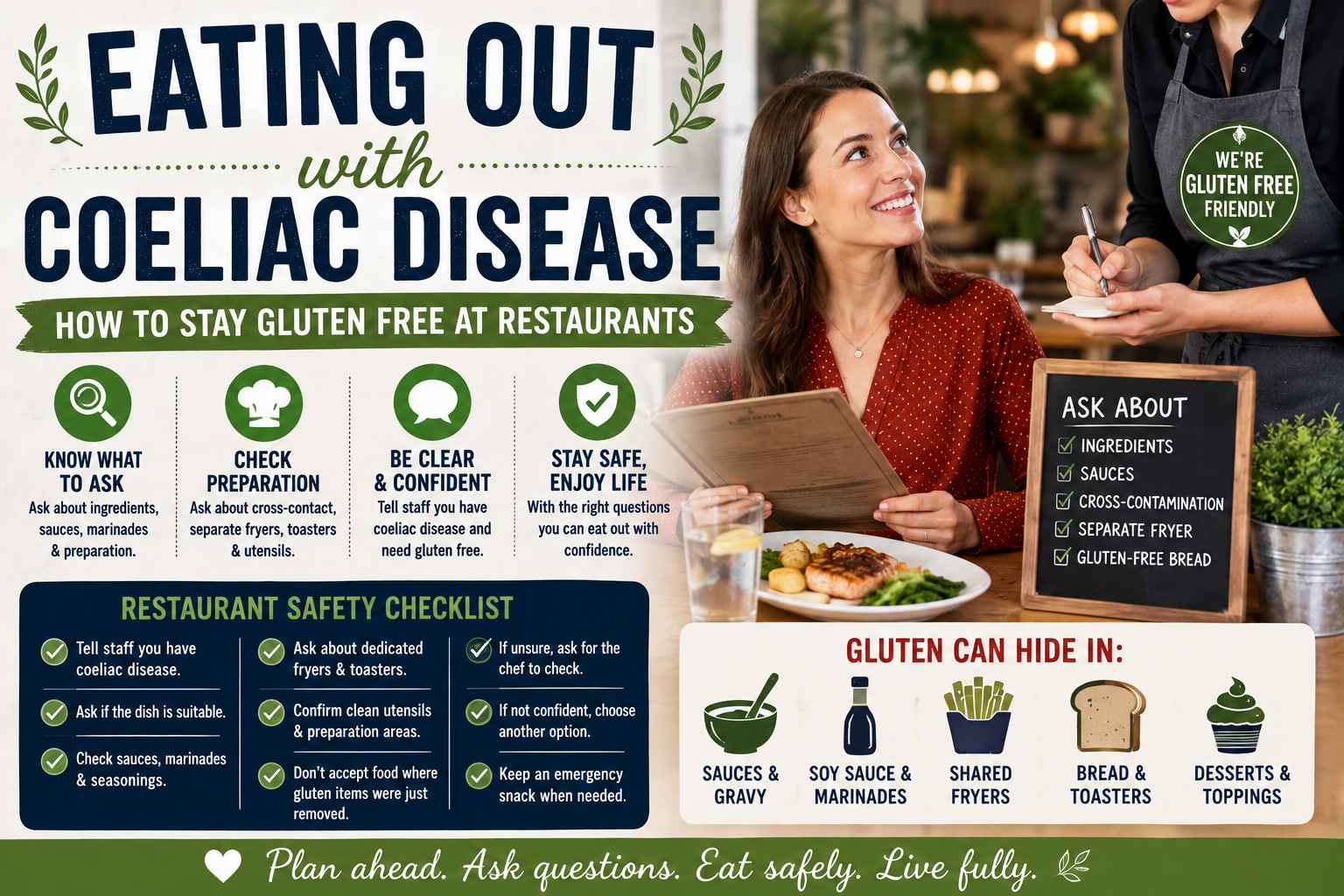
Eating at a restaurant used to be simple.
You looked at the menu, decided what sounded good and ordered it.
After being diagnosed with coeliac disease, that same restaurant menu can suddenly feel like a puzzle.
Is the sauce gluten free?
Are the chips cooked in a shared fryer?
Is the chicken marinated?
Does the seasoning contain gluten?
Is the gluten-free bread toasted separately?
Will the kitchen understand what coeliac disease means?
These are all reasonable questions.
Eating out with coeliac disease requires more planning than it did before your diagnosis, but it doesn’t mean restaurants, cafés, takeaways and celebrations have to disappear from your life.
The key is understanding that there are two things you need to consider:
What’s in the food?
and
How was the food prepared?
A meal can contain completely gluten-free ingredients but still come into contact with gluten in a restaurant kitchen.
This beginner-friendly guide will show you how to choose a restaurant, what questions to ask, what menu items require extra attention and how to feel more confident when eating away from home.
Can You Eat at Restaurants With Coeliac Disease?
Yes.
Having coeliac disease doesn’t mean you can never eat at a restaurant again.
However, because coeliac disease requires a strict gluten-free diet, you need to consider both ingredients and the possibility of gluten cross-contact.
Restaurants vary enormously in how they handle gluten-free food.
Some may have:
- Dedicated gluten-free preparation areas
- Separate fryers
- Separate utensils
- Gluten-free menus
- Staff trained in handling coeliac requirements
Others may offer foods described as gluten free but prepare them in the same areas as regular bread, flour or battered foods.
This is why asking questions is so important.
Gluten Free Doesn’t Always Mean Coeliac-Safe
This is one of the most important things to understand when eating out with coeliac disease.
You may see GF beside a meal on a restaurant menu.
That’s a useful starting point, but it doesn’t necessarily tell you everything about how the meal is prepared.
For example, imagine you order:
Grilled chicken + salad + chips.
The ingredients might appear gluten free.
But what if:
- The chicken is cooked on a surface contaminated with crumbs?
- The marinade contains regular soy sauce?
- Croutons are removed from a pre-made salad?
- The chips share a fryer with battered fish?
The meal may no longer be suitable for someone with coeliac disease.
For this reason, it’s worth telling restaurant staff that you have coeliac disease, rather than simply saying you prefer gluten-free food.
Start by Researching the Restaurant
A little research before leaving home can make the entire experience easier.
Look at the restaurant’s website or online menu.
Search for information about:
- Gluten-free meals
- Allergen menus
- Dietary requirements
- Coeliac-friendly preparation
- Separate fryers
- Gluten-free menus
You can also contact the restaurant directly.
A quick phone call before arriving can save a lot of uncertainty at the table.
What to Ask When You Call a Restaurant
You don’t need to give staff a twenty-question interview.
Start with something simple:
“I have coeliac disease and need to avoid gluten and cross-contact. Are you able to cater for me safely?”
Then, depending on what you’re considering ordering, you might ask:
- Do you have a gluten-free menu?
- Do you have a separate fryer?
- Is gluten-free food prepared separately?
- Do you use separate utensils?
- Is gluten-free bread toasted separately?
- Do you use wheat flour in the kitchen?
- Can staff check ingredients if I’m unsure?
How confidently the restaurant answers can give you useful information.
Tell Your Server You Have Coeliac Disease
When you arrive, tell your server about your dietary requirement before ordering.
Don’t assume information entered during an online booking has reached the kitchen.
You could simply say:
“I have coeliac disease, so I need my meal to be strictly gluten free and protected from cross-contact. Could you please tell me which options are suitable?”
You don’t need to apologise or feel difficult for asking.
You’re giving the restaurant information it needs to help determine whether it can prepare a suitable meal.
Questions to Ask Before Ordering
The exact questions depend on the meal.
Here are some of the most useful.
Is the Dish Gluten Free?
Start with the obvious question.
If the server isn’t sure, ask whether they can check with the kitchen rather than guessing.
Does the Sauce Contain Gluten?
Sauces are one of the easiest places for hidden gluten to appear.
Check:
- Gravy
- Marinades
- Soy sauce
- Teriyaki sauce
- BBQ sauce
- Salad dressing
- Stir-fry sauce
- Curry sauce
A piece of plain meat might be suitable until a gluten-containing sauce is added.
Is There a Separate Fryer?
This is particularly important if you’re ordering:
- Chips/fries
- Hash browns
- Fried chicken
- Fried seafood
- Corn chips
- Other fried foods
If the restaurant fries battered or crumbed foods in the same oil, there is a risk of gluten cross-contact.
Ask specifically whether they have a dedicated gluten-free fryer.
Is Gluten-Free Bread Toasted Separately?
A café may offer gluten-free bread but put it into the same toaster as regular bread.
Regular toasters can contain large amounts of crumbs.
Ask whether gluten-free bread is toasted using separate equipment or another method designed to prevent contact with gluten crumbs.
Is the Grill Shared?
Restaurants may cook:
- Burger buns
- Toasted sandwiches
- Crumbed foods
- Plain meat
on shared cooking surfaces.
Ask whether your food can be prepared on a clean or separate surface when necessary.
Are Clean Utensils Used?
Cross-contact can occur through:
- Tongs
- Knives
- Spatulas
- Chopping boards
- Serving spoons
A restaurant experienced in catering for coeliac disease should have procedures for managing this risk.
Be Careful With Shared Fryers
Shared fryers are one of the biggest things to ask about when eating away from home.
Imagine a fryer is used for:
- Battered fish
- Chicken nuggets
- Onion rings
- Crumbed chicken
- Chips
Even though potatoes don’t naturally contain gluten, chips cooked in the same oil as gluten-containing battered or crumbed food can be exposed to gluten.
So don’t only ask:
“Are the chips gluten free?”
Ask:
“Are the chips cooked in a dedicated gluten-free fryer?”
That gives you much more useful information.
Watch Out for Sauces and Marinades
A grilled chicken breast might look like one of the safest options on the menu.
But it could have been marinated before it reached the grill.
Marinades may contain ingredients such as:
- Regular soy sauce
- Teriyaki sauce
- Malt-containing ingredients
- Seasoning blends
The same applies to meat, seafood and vegetables.
Ask whether the food is marinated and whether the marinade is suitable.
Soy Sauce Is an Easy One to Miss
Traditional soy sauce commonly contains wheat.
That makes it particularly important when eating:
- Sushi
- Stir-fries
- Fried rice
- Asian-style meat dishes
- Marinades
- Dipping sauces
A restaurant may have gluten-free soy sauce or suitable tamari available.
Don’t assume—ask.
Salads Aren’t Automatically Safe
When you’re unsure what to order, a salad can seem like the obvious choice.
But salads can contain:
- Croutons
- Dressings containing gluten
- Crumbed chicken
- Processed meats
- Seasoned toppings
- Crispy noodles
There’s also the possibility of cross-contact during preparation.
If a salad normally comes with croutons, don’t simply ask staff to pick them off.
Ask whether they can prepare a fresh salad without the croutons from the beginning.
Burgers Need More Than a Gluten-Free Bun
Many restaurants now offer gluten-free burger buns.
That’s great—but the bun is only one part of the meal.
Check:
The Patty
Some burger patties contain breadcrumbs, fillers or seasonings.
The Sauce
Check sauces individually.
The Grill
Ask whether the burger can come into contact with regular bread or other gluten-containing foods.
The Bun
Ask how the gluten-free bun is heated or toasted.
The Chips
Ask whether they’re cooked in a shared fryer.
A gluten-free bun doesn’t automatically make the entire burger meal suitable.
Pizza Requires Extra Care
Gluten-free pizza bases are increasingly common.
However, pizza restaurants can be difficult environments for preventing flour cross-contact because wheat flour may be used extensively.
Potential problems include:
- Flour-covered benches
- Shared preparation areas
- Shared utensils
- Shared pizza cutters
- Flour in the kitchen environment
Ask the restaurant what procedures it uses for gluten-free pizzas and whether its gluten-free option is considered suitable for people with coeliac disease.
Cafés and Bakeries
Cafés can be particularly challenging because bread, cakes and pastries are everywhere.
A gluten-free cake sitting beside regular cake in a display cabinet may be exposed to crumbs.
Shared:
- Tongs
- Cake servers
- Chopping boards
- Sandwich presses
- Toasters
can also create cross-contact.
Ask staff how gluten-free food is stored, handled and served.
Don’t Be Afraid to Ask for Simple Food
Sometimes the easiest solution is simplifying the meal.
For example, you might ask for:
Plain grilled chicken
with:
Steamed vegetables and potatoes
without:
Sauce, gravy or seasoning mixes.
A simple meal made from fewer ingredients can be easier for both you and the kitchen to assess.
It might not be the most exciting meal you’ve ever eaten, but having a straightforward fallback option can make eating out much less stressful.
What if the Server Doesn’t Know?
Sometimes you’ll ask a question and get:
“I think it’s gluten free.”
or:
“It should be okay.”
For someone with coeliac disease, uncertainty isn’t particularly helpful.
Politely ask whether they can check with the chef or kitchen.
You could say:
“Would you mind checking with the kitchen for me? I have coeliac disease, so I need to be certain.”
A confident answer based on the ingredients and kitchen procedures is much more useful than a guess.
What if the Restaurant Can’t Cater Safely?
Not every restaurant will be able to safely cater for every dietary requirement.
If staff tell you they can’t guarantee appropriate preparation, take that information seriously.
It can be disappointing, particularly when everyone else is eating.
But it’s better to know before ordering than to assume a meal is suitable.
Depending on the situation, you might choose another restaurant or eat beforehand and join everyone for drinks or socialising.
Don’t Judge Safety by Price
An expensive restaurant isn’t automatically better at catering for coeliac disease.
And a small café isn’t automatically worse.
What’s more important is:
- Staff knowledge
- Ingredient information
- Kitchen procedures
- Communication
- Cross-contact controls
A restaurant that clearly explains what it can and cannot safely provide may be more reassuring than one that simply tells you:
“Everything can be made gluten free.”
Eating Out Gets Easier
Your first restaurant visit after diagnosis may feel uncomfortable.
You may feel like everyone at the table is waiting while you ask questions.
But the process gets easier.
Eventually you’ll know:
- Which questions matter.
- Which menu items require extra checking.
- Which restaurants understand coeliac disease.
- Which places have dedicated fryers.
- Which meals you feel comfortable ordering.
You’ll probably also build a list of favourite restaurants where you’ve had good experiences.
That makes future meals much easier.
Coming Up in Part 2
In Part 2 of Eating Out With Coeliac Disease, we’ll go through different types of restaurants and takeaway foods individually, including:
- Fish and chips
- McDonald’s and other burger restaurants
- Pizza
- Chinese food
- Thai food
- Indian food
- Mexican food
- Sushi
- Italian restaurants
- Cafés
- Bakeries
- Buffets
- Hotel breakfasts
- Food courts
- Parties and family gatherings
We’ll also cover travelling with coeliac disease, what to do when there’s nothing safe on the menu, and how to explain your requirements when you’re overseas.
Eating Out With Coeliac Disease: Restaurants, Takeaways, Cafés & Travelling
Different restaurants come with different risks.
Ordering grilled meat and vegetables at a restaurant is very different from ordering fish and chips, pizza or food from a buffet.
When eating out with coeliac disease, learning where gluten might appear can help you ask the right questions without feeling as though you need to investigate every ingredient in the kitchen.
Here are some of the most common places you might eat and what to check before ordering.
Fish and Chips
You might think chips would be an easy gluten-free choice because potatoes are naturally gluten free.
Unfortunately, the fryer is the problem.
If the same oil is used for:
- Battered fish
- Crumbed fish
- Onion rings
- Chicken nuggets
- Other battered foods
the chips can be exposed to gluten.
Ask:
“Do you have a dedicated gluten-free fryer?”
Some fish and chip shops offer gluten-free batter and dedicated cooking areas.
If they do, it’s still worth asking how the food is prepared.
Burger Restaurants
Burger restaurants increasingly offer gluten-free buns, but don’t stop your questions there.
You may also need to check:
- Burger patties
- Seasonings
- Sauces
- Cheese products
- Fried toppings
- Chips/fries
- Preparation surfaces
Ask whether gluten-free buns are heated separately and whether the chips are cooked in a dedicated fryer.
If you’re ordering from a large fast-food chain, check the company’s current allergen information for your country because ingredients and preparation methods can vary between locations and countries.
Pizza Restaurants
Pizza can be one of the trickier foods when eating out with coeliac disease.
A restaurant may offer a gluten-free base, but wheat flour can be used throughout a pizza kitchen.
Possible sources of cross-contact include:
- Flour on benches
- Shared dough equipment
- Shared utensils
- Shared toppings
- Pizza ovens
- Pizza cutters
Ask the restaurant whether its gluten-free pizzas are suitable for someone with coeliac disease rather than assuming that a gluten-free base means the finished pizza is safe.
Chinese Restaurants
Chinese-style food can contain gluten in places you might not expect.
One major ingredient to check is soy sauce, because traditional soy sauce commonly contains wheat.
Also ask about:
- Oyster sauce
- Hoisin sauce
- Marinades
- Stir-fry sauces
- Batter
- Noodles
- Fried foods
- Shared woks and utensils
Plain steamed rice may be naturally gluten free, but the sauces added to other dishes require investigation.
Some restaurants may offer gluten-free soy sauce or other suitable alternatives.
Thai Restaurants
Thai food can offer plenty of dishes based around:
- Rice
- Rice noodles
- Vegetables
- Meat
- Seafood
- Coconut milk
But that doesn’t automatically make every Thai meal gluten free.
Check:
- Soy sauce
- Oyster sauce
- Fish sauce
- Curry pastes
- Marinades
- Seasonings
Ingredients differ between restaurants and products, so ask rather than assuming.
Indian Restaurants
Many Indian dishes are naturally based around ingredients such as:
- Rice
- Lentils
- Chickpeas
- Vegetables
- Meat
However, there are still gluten-containing foods to watch for.
These can include:
- Naan
- Roti
- Chapati
- Some fried foods
- Some sauces or thickeners
- Shared fryers
Ask about ingredients and preparation methods.
Rice may be a useful alternative to wheat-based breads when appropriate.
Mexican Restaurants
Mexican-style food can also provide gluten-free possibilities, but you need to know whether tortillas are made from corn or wheat.
Check:
- Tortillas
- Taco shells
- Seasoning
- Sauces
- Marinades
- Fried foods
- Shared fryers
Corn Tortillas
Corn itself is naturally gluten free.
However, don’t assume every corn tortilla served in a restaurant is suitable.
Ask about the ingredients and how it’s prepared.
Sushi Restaurants
Sushi can look deceptively safe.
After all, much of it is made from:
- Rice
- Fish
- Vegetables
- Seaweed
But gluten can appear in:
- Regular soy sauce
- Teriyaki sauce
- Tempura
- Marinades
- Some imitation seafood products
- Other sauces
Ask whether gluten-free soy sauce is available and which sushi options are suitable for someone with coeliac disease.
Italian Restaurants
Italian restaurants may seem particularly difficult because menus are often filled with:
- Pasta
- Pizza
- Bread
- Garlic bread
But many restaurants now offer gluten-free pasta or pizza.
If ordering gluten-free pasta, ask whether:
- It is cooked in separate water.
- A clean colander is used.
- The sauce is gluten free.
- Clean utensils are used.
A gluten-free pasta dish still needs to be prepared appropriately.
Steak Restaurants
A plain steak with vegetables or potatoes can potentially be a relatively simple meal.
However, check:
- Marinades
- Seasonings
- Sauces
- Gravy
- Flavoured butter
- Chips
- Shared grills
You can ask for plain meat without sauce if that makes the ingredients easier to confirm.
Cafés
Cafés can have several potential sources of cross-contact.
These include:
- Shared toasters
- Sandwich presses
- Cake cabinets
- Bread crumbs
- Shared tongs
- Shared knives
If you’re ordering gluten-free toast, ask how it is toasted.
If you’re ordering cake, ask how it’s stored and served.
A gluten-free cake sitting directly beside regular cakes may be exposed to crumbs or shared serving utensils.
Bakeries
Traditional bakeries can be especially challenging because large amounts of wheat flour may be used.
Even if a bakery produces a gluten-free item, ask about:
- Where it’s made
- How it’s stored
- Whether equipment is shared
- Whether flour is present during preparation
- How it’s displayed
- How it’s served
A sealed, packaged gluten-free product may present a different situation from an unpackaged product prepared beside wheat-based baking.
Buffets
Buffets are one of the more difficult environments for avoiding cross-contact.
Even if a dish begins completely gluten free, customers may accidentally contaminate it.
For example:
Someone takes the spoon from a pasta dish and puts it into the vegetables.
Someone drops bread crumbs into a salad.
Someone uses the same tongs for regular and gluten-free food.
If possible, talk to staff.
They may be able to provide a fresh portion directly from the kitchen rather than asking you to take food from the buffet.
Hotel Breakfasts
Hotel breakfast buffets can present similar challenges.
Watch for:
- Shared toasters
- Bread crumbs
- Shared serving utensils
- Pancakes and waffles
- Breakfast sausages
- Hash browns
- Cereals
- Granola
- Sauces
Some hotels may have individually packaged gluten-free products.
Ask staff what options are available and how they’re prepared.
Food Courts
Food courts can be convenient, but busy kitchens and shared preparation spaces can make dietary requirements more difficult.
Don’t assume that a dish is safe because its ingredients look gluten free.
Ask the individual food outlet about:
- Ingredients
- Fryers
- Cooking surfaces
- Sauces
- Utensils
If staff can’t confidently answer, another option may be more suitable.
Food Trucks and Markets
Food trucks sometimes have an advantage: their menus can be small.
A business serving only a few dishes may be able to clearly explain every ingredient.
But you still need to ask.
Check:
- Fryers
- Grills
- Sauces
- Bread
- Marinades
- Preparation surfaces
Family Gatherings
Eating at someone else’s house can sometimes feel more awkward than eating at a restaurant.
Your host may genuinely want to help but not understand cross-contact.
They might say:
“Don’t worry, I made you gluten-free chicken.”
But perhaps they:
- Used the same chopping board as regular bread.
- Used regular soy sauce in the marinade.
- Stirred both dishes with the same spoon.
- Put gluten-free food beside regular bread.
This is why clear communication helps.
What to Tell Friends and Family
You don’t need to give them a medical lecture.
Keep it practical.
You might explain:
“I can’t eat wheat, barley or rye, but I also need to avoid crumbs and cross-contact from things like shared utensils and chopping boards.”
Then give them simple suggestions.
For example:
- Use clean utensils.
- Clean the preparation surface.
- Keep bread away from gluten-free food.
- Keep packaging so you can check ingredients.
- Use separate serving spoons.
Offer to Bring a Dish
One of the easiest ways to reduce stress at a family gathering is to bring something yourself.
You could bring:
- A salad
- Dessert
- Gluten-free bread
- A main dish
- Snacks
This guarantees that you’ll have at least one option you know is suitable.
Parties
Parties often involve bowls and platters of shared food.
Watch for:
- Shared dips
- Crackers
- Chips
- Serving utensils
- Cakes
- Pizza
- Finger foods
For example, a dip might be gluten free initially, but after people dip regular crackers into it, crumbs may be introduced.
Taking your own portion before everyone begins sharing can help prevent this.
Weddings and Large Events
If you’re attending a wedding or catered event, contact the organiser or catering company ahead of time when possible.
Tell them that you have coeliac disease rather than simply requesting a gluten-free meal.
Ask how dietary meals are identified and prepared.
Many professional caterers regularly handle dietary requirements, but advance notice makes it easier for them to plan.
Travelling With Coeliac Disease
Travelling can require more planning, but coeliac disease doesn’t mean you have to stop travelling.
Before your trip:
- Research restaurants.
- Find nearby supermarkets.
- Check your accommodation’s cooking facilities.
- Pack safe snacks.
- Learn about gluten-free labelling in your destination.
- Find the national coeliac organisation for the country you’re visiting.
Planning before you arrive can make the trip considerably easier.
Pack Emergency Gluten-Free Food
Delays happen.
Flights get cancelled.
Restaurants close.
You arrive somewhere late at night.
Keeping a few safe foods with you can be extremely useful.
Depending on travel restrictions and your destination, options might include:
- Gluten-free snack bars
- Nuts
- Rice crackers
- Packaged gluten-free biscuits
- Suitable dried fruit
- Other sealed gluten-free snacks
For international travel, check customs and biosecurity requirements before packing food.
Eating at Airports
Airports can be unpredictable.
Some have excellent gluten-free options while others have very little.
Research the airport before travelling if possible.
If you’re uncertain about what will be available, carry suitable snacks through the journey where airport and border rules allow.
Eating on Flights
If your airline offers special meals, you may be able to request a gluten-free meal before travelling.
Do this well in advance and confirm the airline’s current requirements.
However, airline meal policies and preparation procedures vary.
For someone with coeliac disease, it’s still sensible to carry some safe backup food where permitted.
Travelling Overseas
One challenge when travelling internationally is that gluten-free labelling rules aren’t identical everywhere.
A product that meets the legal definition of gluten free in one country may be labelled differently elsewhere.
Before travelling, research:
- Local food-labelling laws
- Common foods
- Restaurant terminology
- National coeliac organisations
Restaurant Cards in Other Languages
If you’re visiting a country where you don’t speak the language, a translated restaurant card can be extremely helpful.
The card can explain that you have coeliac disease and need to avoid:
- Wheat
- Barley
- Rye
- Gluten
- Cross-contact
Some coeliac organisations provide travel cards or information for international travellers.
What if There’s Nothing Safe on the Menu?
This situation will happen occasionally.
First, ask whether the kitchen can make something simple.
For example:
Plain grilled meat + steamed vegetables + plain rice or potato.
Ask about seasonings, cooking surfaces and preparation.
If the restaurant genuinely can’t provide something suitable, don’t pressure staff into promising something they aren’t confident about.
Sometimes the safest choice is simply not to eat there.
Don’t Let Hunger Make the Decision
When you’re extremely hungry, it’s tempting to think:
“It’ll probably be fine.”
That’s why carrying a safe snack can be so useful.
It gives you another option when you’re uncertain rather than forcing you to choose between hunger and a meal you’re not confident about.
Keep a List of Restaurants You Trust
Once you’ve found a restaurant that:
- Understands coeliac disease
- Answers your questions clearly
- Has suitable options
- Handles cross-contact carefully
save it.
Over time, you can build your own list of trusted places.
This makes spontaneous meals much easier.
Check Again When You Return
Even if you’ve eaten somewhere successfully before, it’s worth checking again.
Restaurants can change:
- Menus
- Ingredients
- Suppliers
- Staff
- Kitchen procedures
You don’t need to assume something is unsafe just because it changed, but don’t rely entirely on what happened during your last visit.
Eating Out With Coeliac Disease Doesn’t Have to Mean Staying Home
It can take time to become confident asking questions.
At first, you may feel as though you’re being difficult.
You’re not.
You’re managing a medically required diet.
With practice, eating out with coeliac disease becomes much more manageable.
You learn what to ask, which foods require extra attention and which restaurants make you feel confident about ordering.
Coming Up in Part 3
In the final section, we’ll create a practical guide you can save and refer back to, including:
- Restaurant safety checklist
- What to say to your server
- Questions to ask the chef
- Foods that are usually higher risk
- Simpler meal choices
- Red flags to watch for
- Eating out with children who have coeliac disease
- Dating and social situations
- What to do after accidental gluten exposure
- Frequently asked questions
- Trusted resources
- Final tips for eating out confidently
Eating Out With Coeliac Disease: Your Restaurant Safety Checklist
By now, you know that eating out with coeliac disease involves more than simply finding the letters “GF” on a menu.
You need to consider:
- Ingredients
- Sauces
- Marinades
- Fryers
- Cooking surfaces
- Utensils
- Toasters
- Cross-contact
That might sound like a lot to remember.
Fortunately, you don’t need to ask every restaurant dozens of questions.
Once you understand the common risks, you can concentrate on the questions that matter for the particular meal you’re ordering.
Before Choosing a Restaurant
A little preparation can make eating out much easier.
Before leaving home:
✓ Look at the restaurant’s menu online.
✓ Check whether gluten-free options are identified.
✓ Look for allergen information.
✓ Search the restaurant’s website for information about dietary requirements.
✓ Consider contacting the restaurant beforehand.
✓ Check whether your national coeliac organisation has information about suitable dining options.
Remember that online reviews can be useful for discovering places, but another customer’s experience doesn’t guarantee that a restaurant will always be able to cater safely.
Menus, ingredients and kitchen procedures can change.
What to Say When You Arrive
You don’t need a complicated speech.
Try something like:
“I have coeliac disease, so I need a strictly gluten-free meal and need to avoid cross-contact. Could you please help me choose something suitable?”
This communicates something important:
You’re not requesting gluten free as a preference.
You’re explaining a medical dietary requirement.
Questions to Ask Your Server
Depending on what you’re ordering, ask:
✓ Is this dish suitable for someone with coeliac disease?
✓ Does it contain wheat, barley or rye?
✓ Does the sauce contain gluten?
✓ Is the meat marinated?
✓ Is regular soy sauce used?
✓ Are clean utensils used?
✓ Is the food prepared on a clean or separate surface?
✓ Is gluten-free bread toasted separately?
✓ Is there a dedicated gluten-free fryer?
✓ Can the kitchen check the ingredients if we’re unsure?
You probably won’t need to ask every question.
Choose the ones relevant to your meal.
Questions About Chips and Fried Food
If you’re ordering chips, don’t only ask:
“Are the chips gluten free?”
Instead ask:
“Are they cooked in a dedicated gluten-free fryer?”
This helps you find out whether battered or crumbed foods are cooked in the same oil.
The same applies to other fried foods.
Questions About Pasta
If ordering gluten-free pasta, consider asking:
- Is it cooked in separate water?
- Is a clean pot used?
- Is a clean colander used?
- Is the sauce gluten free?
- Are clean utensils used?
Putting gluten-free pasta into water previously used for wheat pasta can create cross-contact.
Questions About Pizza
Ask:
- Is the base gluten free?
- Where is it prepared?
- Is wheat flour used nearby?
- Are separate utensils used?
- Is a clean pizza cutter used?
- Is the finished pizza considered suitable for someone with coeliac disease?
Pizza kitchens can use large amounts of flour, so preparation procedures are particularly important.
Questions About Burgers
Ask about:
- The burger patty
- The bun
- Sauces
- Seasonings
- Grill preparation
- Fried toppings
- Chips
A gluten-free bun doesn’t automatically mean the entire burger meal is gluten free.
Higher-Risk Restaurant Foods
No food is automatically unsafe simply because it appears on this list, but these foods often require additional questions.
Fried Food
Because of shared fryers.
Pizza
Because of wheat flour and shared preparation areas.
Pasta
Because of shared cooking water, colanders and utensils.
Bakery Food
Because flour and crumbs may be present throughout the preparation environment.
Buffets
Because customers can move serving utensils between dishes.
Sauces and Gravy
Because they may contain flour, soy sauce or other gluten-containing ingredients.
Marinated Meat
Because marinades may contain regular soy sauce or other gluten-containing sauces.
Desserts
Because biscuit bases, crumbs, wafers and shared serving utensils can introduce gluten.
Simpler Restaurant Choices
Sometimes choosing a simpler meal makes ingredients easier to investigate.
Depending on preparation, examples might include:
- Plain grilled meat
- Plain grilled fish
- Steamed vegetables
- Baked potato
- Plain rice
- Simple salad without croutons
- Eggs prepared on a clean surface
However, never assume these are automatically safe.
For example, plain meat may still have been marinated or cooked on a contaminated surface.
Ask first.
Restaurant Red Flags
There are some responses that should encourage you to ask more questions.
“A Little Gluten Won’t Hurt.”
For someone with coeliac disease, intentionally consuming small amounts of gluten isn’t considered safe.
“We Can Just Take the Bread Off.”
Removing gluten-containing food after it has already touched the meal doesn’t undo the contact.
A fresh meal should be prepared appropriately.
“The Chips Are Gluten Free Because They’re Potatoes.”
Ask about the fryer.
The potatoes may be naturally gluten free, but the cooking oil may be shared with battered foods.
“It’s Wheat Free.”
Remember:
Wheat free isn’t necessarily gluten free.
Barley and rye also contain gluten.
“I’m Pretty Sure.”
If someone isn’t certain, politely ask whether they can check.
You want information rather than a guess.
Good Signs at a Restaurant
Some things can make dining easier.
Positive signs include:
- Staff understand what coeliac disease means.
- Questions are taken seriously.
- Staff are willing to check with the kitchen.
- Allergen information is available.
- Separate fryers or preparation procedures are used where necessary.
- Staff explain what they can and cannot safely provide.
Interestingly, a restaurant saying:
“We can’t safely prepare that particular dish for you.”
can actually be reassuring.
It shows they’re recognising limitations rather than simply promising that everything is safe.
Eating Out With a Child Who Has Coeliac Disease
A child’s diagnosis creates additional challenges because they may not yet understand why they can’t share food with friends.
When eating out:
- Tell staff about your child’s coeliac disease.
- Check meals yourself.
- Explain why food shouldn’t be shared.
- Bring an emergency snack.
- Check desserts carefully.
- Ask about fryers and preparation.
As children get older, teach them how to ask questions themselves.
For example:
“Is this gluten free?”
and eventually:
“Is this suitable for someone with coeliac disease?”
Learning these skills can help children become more confident managing their diet independently.
Birthday Parties
Birthday parties can be difficult for children because pizza, cake and party snacks frequently contain gluten.
Speak to the host beforehand.
Depending on the situation, you might provide:
- Gluten-free pizza
- A gluten-free cupcake
- Safe snacks
- A separate portion of party food
This allows the child to participate without having to sit and watch everyone else eat.
Dating With Coeliac Disease
A first date is probably not when you want to deliver a lecture about cross-contact.
Fortunately, you don’t have to.
Choose a restaurant you’ve researched beforehand and briefly explain that you have coeliac disease and need to eat gluten free.
If the relationship progresses, your partner can gradually learn about:
- Shared food
- Cooking
- Crumbs
- Restaurant choices
- Gluten-containing ingredients
Someone doesn’t need to understand everything immediately.
Social Events
Sometimes social events revolve around food.
Work functions, parties, weddings and family gatherings may all have limited gluten-free options.
Planning helps.
Consider:
- Contacting the organiser.
- Eating something beforehand.
- Taking a safe snack.
- Bringing a dish if appropriate.
- Asking catering staff directly.
Having a backup option can prevent you from feeling pressured to eat something you’re uncertain about.
What if You Accidentally Eat Gluten?
Accidental gluten exposure can happen even when you’re careful.
If you believe you’ve accidentally eaten gluten, return to your usual strict gluten-free diet.
There isn’t a proven treatment that can “cancel out” gluten after it has been eaten.
Depending on your symptoms, you may find it helpful to rest and stay appropriately hydrated.
If symptoms are severe, unusual, persistent, or you’re worried about your health, contact a healthcare professional.
For repeated accidental exposures, talk with your doctor or dietitian to help identify where gluten may be entering your diet.
Don’t Blame Yourself for Every Symptom
Having stomach symptoms after eating at a restaurant doesn’t automatically prove that you were exposed to gluten.
Digestive symptoms can have many causes.
Similarly, having no symptoms doesn’t prove a meal was gluten free.
That’s why it’s better to assess the ingredients and preparation practices rather than relying on how you feel afterwards.
Frequently Asked Questions About Eating Out With Coeliac Disease
Can People With Coeliac Disease Eat at Restaurants?
Yes.
Many restaurants can cater for people with coeliac disease, but you should ask about both ingredients and cross-contact.
Is a Gluten-Free Menu Safe for Coeliac Disease?
Not automatically.
A gluten-free menu tells you that gluten-free options are offered, but you may still need to ask how food is prepared.
Can Coeliacs Eat Restaurant Chips?
Potentially.
The chips themselves may be gluten free, but you need to find out whether they’re cooked in a fryer shared with battered or crumbed foods.
Ask about a dedicated gluten-free fryer.
Can Coeliacs Eat Pizza?
Gluten-free pizza may be suitable depending on the ingredients and preparation.
Pizza kitchens can have a high risk of flour cross-contact, so ask the restaurant whether its gluten-free pizza is suitable for someone with coeliac disease.
Can Coeliacs Eat Sushi?
Some sushi may be suitable.
However, traditional soy sauce commonly contains wheat, and sushi can also contain tempura, marinades and sauces.
Check before ordering.
Can Coeliacs Eat Indian Food?
Some Indian dishes may be gluten free, but ingredients and preparation methods vary.
Wheat-based breads such as naan and roti contain gluten unless specially made gluten free.
Ask the restaurant about individual dishes.
Can Coeliacs Eat Thai Food?
Some Thai dishes may be suitable, but sauces and seasonings need checking.
Ask about soy sauce, oyster sauce, fish sauce, curry pastes and marinades.
Can Coeliacs Eat Chinese Food?
Some dishes may be suitable, but traditional soy sauce is a common source of wheat.
Ask about sauces, marinades, batter, noodles and cross-contact.
Can Coeliacs Eat McDonald’s or Other Fast Food?
Fast-food ingredients, allergen information and kitchen procedures vary between chains, locations and countries.
Don’t rely on information from another country or an old social-media post.
Check the restaurant’s current official allergen information for your location before ordering and ask about shared preparation equipment where relevant.
Screenshot This: Eating Out With Coeliac Disease Checklist
Before ordering, remember:
☐ Tell staff you have coeliac disease.
☐ Ask whether the dish is suitable.
☐ Check sauces and marinades.
☐ Ask about soy sauce where relevant.
☐ Ask whether fryers are shared.
☐ Check how gluten-free bread is toasted.
☐ Ask about cooking surfaces.
☐ Check that clean utensils are used.
☐ Don’t accept food where gluten-containing items have simply been removed.
☐ If staff don’t know, ask them to check with the kitchen.
☐ If you aren’t confident about the answer, choose another option.
Save this checklist on your phone so you can use it when you’re eating away from home.
Building Confidence With Eating Out
Your first few restaurant visits after diagnosis may feel exhausting.
You’ll probably read menus differently.
You’ll notice bread baskets.
You’ll wonder about fryers.
You’ll ask questions you’ve never had to ask before.
But it does become easier.
You’ll discover restaurants that understand coeliac disease.
You’ll find meals you know how to order.
You’ll learn the questions that matter.
And eventually, eating out with coeliac disease can become enjoyable again rather than something you dread.
Key Takeaways
Remember these points:
- Tell staff you have coeliac disease.
- Don’t rely only on a GF symbol.
- Ask about ingredients and preparation.
- Check sauces and marinades.
- Ask about dedicated fryers.
- Watch for shared toasters and cooking surfaces.
- Don’t allow staff to simply remove gluten-containing food from your meal.
- Research restaurants before travelling.
- Carry emergency snacks when appropriate.
- Keep a list of restaurants where you’ve had good experiences.
- Check again when menus or procedures change.
You don’t have to stop enjoying restaurants because you have coeliac disease.
You simply need more information before deciding what to order.
Final Thoughts
Eating out with coeliac disease can feel intimidating when you’re newly diagnosed.
At home, you control the ingredients.
At a restaurant, you’re trusting someone else to prepare your food.
That’s why communication matters so much.
Tell staff what you need.
Ask clear questions.
Listen carefully to their answers.
And don’t feel pressured to eat something when you aren’t confident about how it was prepared.
Over time, you’ll develop your own collection of trusted restaurants, favourite meals and questions that help you make informed choices.
A coeliac disease diagnosis changes how you eat out.
It doesn’t mean you have to stop eating out altogether.
Related Guides
Foods You Can Eat With Coeliac Disease: Complete Gluten-Free Food List
Foods to Avoid With Coeliac Disease: Complete Gluten-Free Guide
Common Hidden Sources of Gluten: Foods, Drinks & Everyday Products to Watch Out For
How to Read Gluten-Free Food Labels: A Beginner’s Guide
How to Avoid Gluten Cross-Contamination With Coeliac Disease
The Ultimate Gluten-Free Shopping Guide
How to Get Diagnosed With Coeliac Disease: Symptoms, Testing & Where to Get Help
Trusted Resources
For current advice about coeliac disease and eating gluten free, readers can consult reputable organisations such as:
- Coeliac New Zealand – https://coeliac.org.nz
- Health New Zealand | Te Whatu Ora – https://www.tewhatuora.govt.nz
- Coeliac Australia – https://www.coeliac.org.au
- Coeliac UK – https://www.coeliac.org.uk
- Celiac Disease Foundation – https://celiac.org
- Beyond Celiac – https://www.beyondceliac.org
- Canadian Celiac Association – https://www.celiac.ca
When travelling internationally, check guidance from the national coeliac organisation for your destination because food labelling and restaurant practices can differ between countries.
Medical Disclaimer
This article is for general educational purposes only and doesn’t replace medical or dietary advice from a qualified healthcare professional.
If you’ve been diagnosed with coeliac disease and need help managing a gluten-free diet, speak with your doctor or an appropriately qualified dietitian.
Leave a Reply
You must be logged in to post a comment.